


Table of Contents
- Why Beef Liver Is Good for Cats With Sensitive Stomachs
- Freeze Dried Beef Liver for Cats: A Gentle Protein Option
- How to Introduce New Treats to Cats With Sensitive Stomachs
- Benefits of Single-Ingredient Cat Treats
- How Much Beef Liver Can a Cat Safely Eat?
- Tracking Your Cat's Response: A Simple Symptom Log
- Frequently Asked Questions
Last Updated: September 13, 2026
Why Beef Liver Is Good for Cats With Sensitive Stomachs
The question of is beef liver good for cats with sensitive stomachs has a short answer and a longer one. The short answer: yes, for most cats, when it is fed in small amounts and introduced slowly. The longer answer involves understanding what makes liver different from other proteins, and why a cat who vomits after eating a chicken-based treat might handle beef liver without any trouble at all.
This guide from Simplified Freeze Dried walks through the nutrient profile, the safe serving thresholds, and a transition protocol built specifically for cats whose digestion is easily thrown off.

Here is the part most guides skip: sensitivity is not the same as allergy. A cat with a true food allergy reacts to a specific protein. A cat with a sensitive stomach reacts to how much food arrives at once, how rich it is, or how abruptly the diet changed. Liver is nutrient-dense, which makes it a poor candidate for a large sudden portion but an excellent candidate for a small, controlled one.
Cornell Feline Health Center on feeding your cat
The Nutrient Profile of Beef Liver
Beef liver is one of the most nutrient-dense organ meats available, delivering concentrated vitamin A, B-vitamins, iron, and taurine in a small volume. That density is the whole point. A cat eating a thumbnail-sized piece of freeze-dried liver takes in more usable micronutrients than it would from a much larger portion of muscle meat.
The nutrients that matter most here:
- Taurine, an amino acid cats cannot synthesize in sufficient quantities and must get from food
- B-vitamins, including B12, which supports metabolic health and red blood cell production
- Iron, in a form that is more bioavailable than plant-based iron
- Vitamin A, which cats cannot convert efficiently from plant sources
Because liver is so concentrated, the serving size stays small. That works in your favor with a sensitive cat: you are asking its digestive system to process a tiny amount of very rich food rather than a large amount of moderate food.
How Liver Supports Digestive Health
Liver does not "fix" a sensitive stomach, and any product claiming that should be treated with suspicion. What liver does is deliver highly digestible protein with very little connective tissue and almost no filler. For a cat whose gastrointestinal sensitivity is triggered by grains, binders, or artificial additives, a single-ingredient liver treat removes most of the usual suspects in one step.
Digestibility matters more than most owners realize. Protein density that a cat can actually break down and absorb produces smaller, firmer stools and less gas. Protein the gut cannot handle produces the opposite. This is why the source and processing method matter as much as the ingredient itself.
Freeze Dried Beef Liver for Cats: A Gentle Protein Option
Freeze dried beef liver for cats works well as a first protein when the question is beef liver good for cats with sensitive stomachs, because it is a single ingredient, not a formula. There is nothing to react to except the liver itself. If your cat tolerates it, you have learned something useful. If it does not, you have ruled out one variable cleanly.
That clarity is the real advantage. Multi-ingredient treats make elimination testing nearly impossible. When a cat reacts, you cannot tell whether the trigger was the protein, the binder, the preservative, or the flavoring.
Simplified Freeze Dried makes single-ingredient beef liver treats for both dogs and cats, using 100% American beef liver with no imported meat and no denatured product. The liver is cut once and freeze-dried, with nothing added in between. The treats come in regular pieces and small kibble-sized pieces.
For training, the kibble-sized pieces are the practical choice. They are small enough to hand out repeatedly in a session without overfeeding, and small enough that a cat with a sensitive stomach gets a taste of liver rather than a meal of it. The regular-sized pieces are for occasional treating only, they are simply too large to use as a repeated training reward, and using them that way is one of the most common ways owners accidentally trigger a reaction.
AAHA nutritional assessment guidelines for dogs and cats
How to Introduce New Treats to Cats With Sensitive Stomachs
Introducing a new treat to a sensitive cat is a controlled experiment, not a feeding. The goal is to change exactly one variable at a time and watch what happens over several days. Most owners fail here not because they feed the wrong thing but because they change too many things at once and cannot tell what caused a reaction.
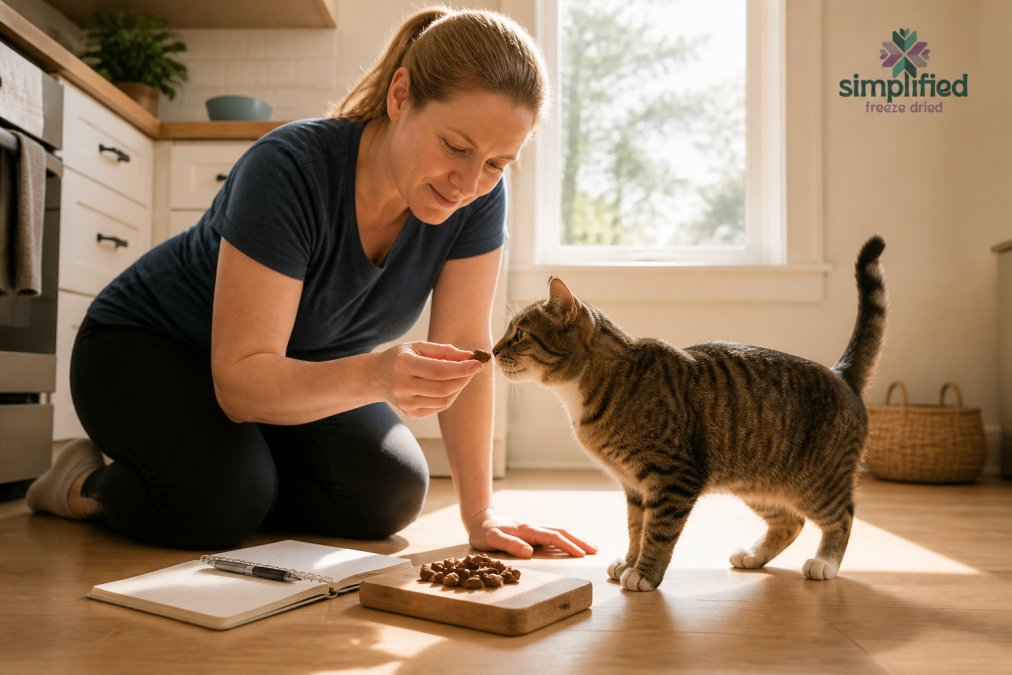
A Step-by-Step Transition Protocol
This protocol is built around one principle: start below the threshold that could trigger a reaction, then climb slowly. The amounts below assume a mini-sized, kibble-sized piece of single-ingredient freeze-dried liver.
- Start with a crumb, not a piece. Break off roughly a quarter of a mini-sized piece and offer it by hand. At this size you are testing tolerance, not nutrition.
- Wait 24 hours. Watch for vomiting, diarrhea, lethargy, or appetite loss. Most reactions to a new protein show up within a day. If nothing happens, you have cleared the first gate.
- Repeat the same small amount for three days. Consistency tells you more than variety does at this stage. Three clean days at a quarter piece is a stronger signal than one clean day at a full piece.
- Increase gradually. Move to a half piece, then a full mini-sized piece, holding each step for two to three days. If a step produces soft stool, hold at the previous amount for another two days before advancing.
- Keep everything else identical. Do not change the main diet, add supplements, or introduce another treat during the test. One variable at a time is the entire point.
- Stop at the first sign of trouble. If symptoms appear, pause the treat and let the gut settle for several days before deciding whether to retry at a lower amount.
Most cats who tolerate liver at all will show it within the first week. A cat that reaches a full mini-sized piece with normal fecal consistency and steady appetite is a cat that handles beef liver well.
Why Mini-Sized Pieces Matter for Training
If you are using liver as a training reward, portion discipline is the whole game. A training session can involve ten or more rewards in a few minutes, so the size of each reward determines whether you are reinforcing behavior or overfeeding. Mini-sized pieces are built for this: they are small enough to hand out repeatedly without pushing a sensitive cat past its tolerance ceiling. Regular-sized pieces are for occasional treating only, they are simply too large to use as a repeated training reward, and using them that way is one of the most common ways owners accidentally trigger a reaction.
Preparation Before You Feed
How you handle the piece before it reaches your cat affects how the gut receives it:
- Feed it dry for the first few days. A dry piece is the least rich format and the easiest to control by size.
- If you rehydrate, use plain warm water, not broth, not milk, not oil. Broth and oil add fat and sodium that can trigger a sensitive gut independently of the liver.
- Never add a topper or mix it into the main meal during the test phase. Mixing hides how much the cat actually ate and makes a reaction impossible to attribute.
Track It, Do Not Remember It
A transition protocol only works if you can see the pattern. Owners routinely misremember how their cat reacted three days ago, which is why a written log turns guesswork into data. The next section gives you a simple one to use.
Benefits of Single-Ingredient Cat Treats
Single-ingredient treats solve a problem that multi-ingredient products create: they make reactions traceable. When the treat contains one thing, a bad reaction points to one suspect.
The benefits stack up beyond that:
- Elimination diets become possible. You can test proteins one at a time instead of guessing.
- Hypoallergenic feeding gets simpler. Fewer ingredients means fewer chances of hitting a trigger.
- Label reading gets faster. One line, one ingredient, no binder or preservative hunt.
- Portion control gets easier. You know exactly what you are feeding and how much.
For cats with food intolerances, this is not a minor convenience. It is the difference between a treat you can trust and a treat you have to gamble on.
How Much Beef Liver Can a Cat Safely Eat?
A cat can safely eat beef liver in small amounts as a treat, not as a meal replacement. The practical rule is that treats should stay a small fraction of daily calories, and liver's vitamin A concentration makes portion discipline more important than it is with muscle meat.

A reasonable starting point for most cats is one to two kibble-sized pieces per day, adjusted for body weight and how the cat responds. Large cats can handle slightly more. Small cats and seniors should start lower.
Signs you are overfeeding liver:
- Loose stools or a sudden change in fecal consistency
- Vomiting shortly after eating
- Reduced appetite for the main diet
- Lethargy or unusual behavior
Vitamin A toxicity in cats is real, but it develops from sustained overfeeding of liver as a large part of the diet, not from a few small treats. The risk comes from treating liver as food rather than as a reward.
Tracking Your Cat's Response: A Simple Symptom Log
A symptom log turns guesswork into data. Most owners try to remember how their cat reacted three days ago and cannot. Writing it down takes thirty seconds a day.
| Day | Treat Amount | Appetite | Fecal Consistency | Vomiting | Energy Level | Notes |
|---|---|---|---|---|---|---|
| 1 | 1/4 piece | Normal | Normal | No | Normal | First taste, ate readily |
| 2 | 1/4 piece | Normal | Normal | No | Normal | No change |
| 3 | 1/2 piece | Normal | Slightly soft | No | Normal | Watch next day |
| 4 | 1/2 piece | Normal | Normal | No | Normal | Settled |
| 5 | 1 piece | Normal | Normal | No | Normal | Tolerating well |
Track for at least a week before drawing conclusions. Bring the log to your veterinarian if you are managing a known gastrointestinal condition, since it gives them a clear picture of what changed and when.
FDA Center for Veterinary Medicine pet food resources
Figuring out whether a cat can handle a new treat is slow work, and it gets harder when the treat itself is a mystery. Simplified Freeze Dried makes that part simple: single-ingredient beef liver, 100% American sourced, cut once and freeze-dried with nothing added. The kibble-sized pieces are built for training sessions, and the regular pieces work for occasional treating. If you are working through a sensitivity issue and want one variable you can actually control, start with a treat that has only one ingredient to question. Get started with Simplified Freeze Dried and give your cat a reward you can trace back to a single source.
Frequently Asked Questions
Can cats eat beef liver every day?
Beef liver is nutrient-dense, so daily feeding is not recommended. Most veterinarians suggest offering liver treats two to three times per week in small amounts. For cats with sensitive stomachs, start with one small piece and monitor for digestive distress. Overfeeding liver can lead to vitamin A toxicity, which causes lethargy, appetite loss, and joint pain. Keep portions modest and pair liver with a balanced diet.
How much beef liver can a cat safely eat?
A safe serving is roughly one small kibble-sized piece per 10 pounds of body weight, given as a treat rather than a meal replacement. For sensitive cats, begin with a single piece and wait 48 hours before offering more. Liver should make up no more than 5 percent of daily calorie intake. Exceeding this can cause vitamin A toxicity and digestive upset.
Are single-ingredient treats better for cats with digestive issues?
Single-ingredient treats reduce the number of potential triggers, which helps identify food intolerances. When a treat contains only freeze dried beef liver, you can quickly tell whether your cat reacts to that protein or something else. This simplicity supports an elimination diet approach and makes it easier to track fecal consistency, vomiting, and appetite changes after introducing a new food.
What should I do if my cat has a reaction to beef liver?
Stop offering the treat immediately and note the symptoms, such as vomiting, diarrhea, or lethargy. Wait 72 hours to see if signs resolve. If they persist, contact your veterinarian. Once your cat is stable, you can try a different single-ingredient protein or reintroduce liver in a much smaller amount. Keeping a symptom log helps your vet identify the trigger faster.