


Table of Contents
- Why Pet Product Safety Standards Are Hard to Verify
- Who Actually Regulates Pet Products
- Your Pet Food Ingredient Label Guide
- How to Check Pet Food Recalls
- Questions to Ask Pet Food Manufacturers
- How to Validate Certificates, Test Reports, and Claims
- Conclusion
- Frequently Asked Questions
Last Updated: October 17, 2026
Why Pet Product Safety Standards Are Hard to Verify
Pet product safety is not one system. This guide from Simplified Freeze Dried walks through how to verify pet product safety standards step by step, so you can check claims instead of trusting them.
Here is the core problem. A bag of treats and a chew toy sit on the same store shelf, but they are governed by completely different rules. Treats fall under feed law.
That gap is where confusion lives. A label that says "premium" or "natural" tells you almost nothing about testing. What matters is documentation you can actually check.
Below, we break down who regulates what, how to read a label, and how to validate the paperwork behind a claim.
Who Actually Regulates Pet Products
Pet food and treats are regulated at two levels: the federal Food and Drug Administration sets the baseline, and state feed officials enforce rules on the ground. Non-food products like toys, beds, and bowls fall under different consumer product rules.
That split is the first thing to understand. It explains why a treat label looks nothing like a toy package.
Pet Food and Treats vs. Non-Food Products
Pet food and treats are treated as animal feed. That means ingredient rules, labeling rules, and facility rules apply.
Non-food items are different. Toys, chews, and grooming tools are covered by consumer product safety rules focused on hazards like choking, sharp edges, and toxic materials. No feed-style ingredient panel is required.
So the question "is this product safe?" depends entirely on the product type. Keep that distinction in mind for everything below.
Your Pet Food Ingredient Label Guide
A pet food ingredient label is a legal document, not marketing copy. It lists ingredients in descending order by weight, and it must follow set naming rules. Learning to read it is the fastest way to spot a weak product.
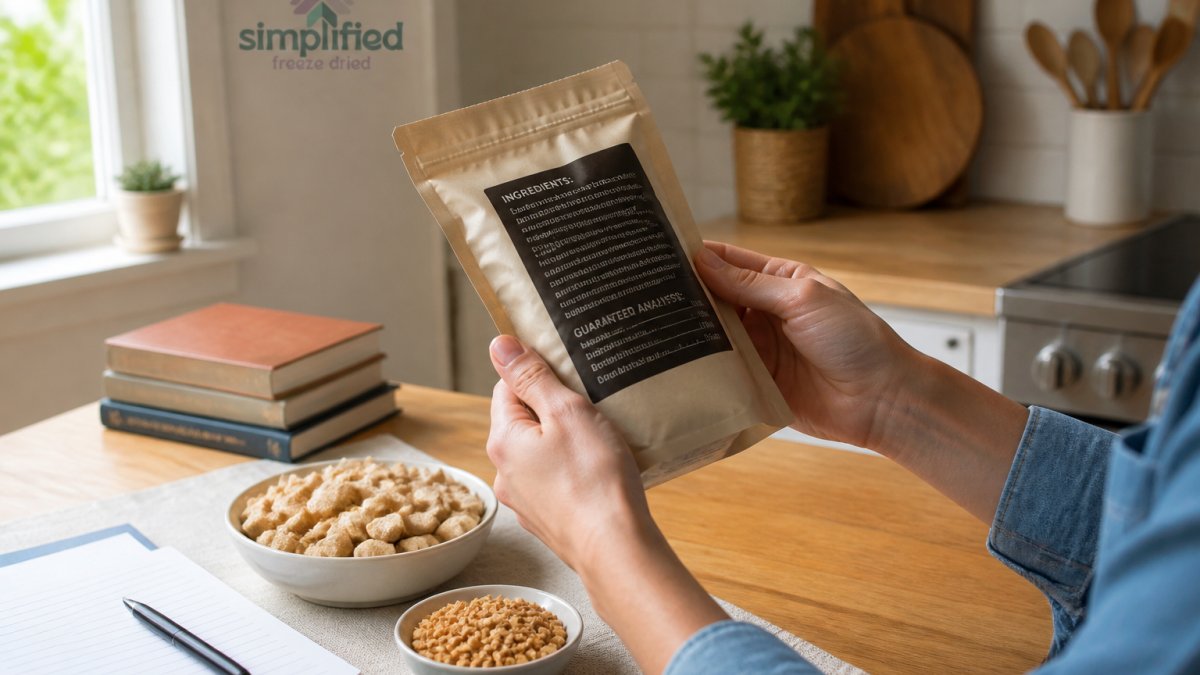
Start with the first five ingredients. Those make up most of the product.
Next, look for what is missing. A single-ingredient product should list one ingredient. If you see binders, preservatives, or "natural flavor" on a product sold as pure, that is a red flag.
Reading the AAFCO Statement and Guaranteed Analysis
The AAFCO statement tells you whether the food is complete and balanced, and for which life stage. It is a required statement on pet food, and it is one of the most useful things on the bag. The AAFCO's labeling and labeling guidelines explains what that statement must contain.
The guaranteed analysis lists minimum and maximum nutrient levels. It is not a full nutritional breakdown, but it does let you compare products on protein, fat, and fiber.
Here is what to check on the label:
- Ingredient list: first five items, and whether the list matches the claim
- AAFCO statement: complete and balanced, and for which life stage
- Guaranteed analysis: protein, fat, fiber minimums and maximums
- Manufacturer name and address: a real, contactable company
- Country of origin: where the ingredients and product come from
How to Check Pet Food Recalls
Recalls are public, and checking them takes about two minutes. The FDA publishes recall notices for pet food and treats, and the FDA recall database is the place to search.
Do this before you buy a new brand, and again if your pet gets sick after eating. Recalls are not proof a brand is bad. They are proof the system is working.
What to look for in a recall notice:
- The exact product name, lot code, and date range
- The reason for the recall (contamination, mislabeling, foreign material)
- Whether the recall was voluntary or requested
- The company's response and corrective action
A brand that publishes recall info openly and acts fast is often more trustworthy than one that never mentions recalls at all.
Questions to Ask Pet Food Manufacturers
A manufacturer's answers tell you more than any label. Ask direct questions and listen for specifics. Vague answers are a signal.
Try these:
- Where do your ingredients come from, and can you name the supplier?
- Do you use human-grade meat, or meat that is denatured or unfit for human consumption?
- Can you share a third-party test report for this product, and which lab issued it?
- What is your lot code and traceability process?
- How do you handle a recall or a customer complaint?
- Which specific standard or regulation does this product fall under, and can you show the documentation?
At Simplified Freeze Dried, we answer these plainly. Our beef liver is 100% American and human-grade, never imported and never denatured. Our pumpkin is 100% American pumpkin sourced from the Midwest.
That is the level of detail you should expect from any maker. If a company cannot tell you where its ingredients come from, that silence is information.
A Category-by-Category Verification Checklist
The questions change with the product. Use this checklist to match your checks to what you are buying, so you do not apply a food standard to a toy or a toy standard to a treat.
| Product category | Main hazards | What to verify |
|---|---|---|
| Treats and food | Contamination, mislabeling, allergens | Ingredient list, AAFCO statement, recall history, third-party test report with lot linkage |
| Chews and bones | Choking, splintering, digestion | Size guidance, material source, breakage warnings, species suitability |
| Toys | Choking, sharp edges, toxic materials | Age labeling, small-part warnings, material safety, construction quality |
| Bowls and feeders | Chemical leaching, sharp edges | Food-contact material claims, finish quality, stability |
| Beds and fabrics | Flammability, dyes, loose parts | Material disclosure, washability, stitching quality |
| Collars and leashes | Breakage, entrapment, hardware failure | Hardware strength claims, buckle type, sizing guidance |
For treats specifically, the biggest risk is an undeclared ingredient. That is why a short, clear ingredient list matters. A single-ingredient treat leaves little room to hide an allergen.
Red Flags in Seller Answers
Watch for answers that dodge the specific question. A seller who says "we follow all regulations" without naming the standard, or who cannot produce a test report tied to a lot, is giving you a slogan rather than evidence. A prompt, specific answer, with a document to back it, is the strongest signal you can get before you buy.
How to Validate Certificates, Test Reports, and Claims
A certificate or test report is only useful if you can check it. Many buyers never do, which is why weak documents survive. Validation means confirming the issuer, the scope, and the date, and knowing what a document can and cannot prove.
Start with the certificate itself. Look for the issuing body, the standard it covers, and the expiration date. Then confirm the issuer is real and accredited. A certificate from an unknown body with no contact details is decoration.
For test reports, check three things:
- The lab: is it accredited, and for the right test?
- The scope: does the report cover the exact product and lot you are buying?
- The date: is it recent enough to reflect current production?
How to Confirm a Lab or Certification Body Is Accredited
A logo on a report proves nothing until you confirm the issuer. Most reputable testing labs and certification bodies are accredited by an independent accreditation organization, and that accreditation is usually searchable.
A common pattern is a report issued by a lab that is accredited for chemistry but not for microbiological testing, or a certificate issued by a body that is not accredited for the standard it claims to certify.
What a Test Report Should Actually Show
A usable test report is specific. It should identify the product by name and lot code, state the test method and the standard version used, show the result against the limit, and carry a report date and a unique report number. If any of those are missing, the report is too vague to rely on.
Watch for these common problems:
- Product mismatch: the report covers a different product, size, or flavor than the one you are buying.
- Stale date: the report is old enough that current production may differ.
- Narrow scope: the report tests one attribute (for example, protein content) but the seller presents it as proof of overall safety.
- No lot linkage: the report cannot be tied to the batch in your cart.
The Limits of Common Claims and Certifications
Terms like "certified," "lab-tested," or references to food standards do not automatically prove every product is safe or independently tested. A certification may cover a facility's process rather than the finished product, or it may cover one product line and not another.
When a seller leans on a logo, ask three questions: What standard does this certificate cover? Which product and lot does it apply to? Who issued it, and are they accredited for that standard?
A Practical Document-Check Workflow
Use this sequence before you buy:
- Identify the product type. Food and treats follow feed rules; toys, beds, and bowls follow consumer product rules. The document you need depends on the category.
- Ask for the specific document. Request the test report or certificate by product name and lot code, not a generic PDF.
- Confirm the issuer. Look up the lab or certification body and its accreditation.
- Check the scope and date. Confirm the report covers the exact item and is recent.
- Cross-check recalls. Search the FDA recall database for the brand and product.
- Ask the seller to explain any gap. A specific, prompt answer is a good sign; silence or deflection is information.
That workflow turns a logo into evidence you can actually evaluate.
Conclusion
Verifying pet product safety standards comes down to one habit: ask for the document, then check it.
That is the standard we hold ourselves to at Simplified Freeze Dried. Our mini-sized pieces are built for training, while the regular size is a treat, not a training reward.
Get started with Simplified Freeze Dried and give your pet a reward you can trace back to the source.
Frequently Asked Questions
Is pet food regulated by the government?
Yes, but not the way human food is. The FDA oversees pet food and treats under the Federal Food, Drug, and Cosmetic Act, and states enforce their own feed laws, often using AAFCO model regulations as a template. That means requirements vary by state, and many safety practices, like third-party testing or GMP audits, are voluntary. Pet product safety depends heavily on the manufacturer choosing to go beyond the legal minimum.
How can I check whether a pet food or treat is safe?
Start with the label: confirm a named animal source as the first ingredient, look for a complete AAFCO nutritional adequacy statement, and check the manufacturer's name and address. Then search the FDA recall database and the manufacturer's own recall page for past incidents. Finally, contact the company and ask about sourcing, testing, and manufacturing audits. A brand that answers those questions clearly is a better sign of pet product safety than any single claim on the package.
How do I check whether a pet product has been recalled?
Search the FDA's recall and market withdrawal database by brand and product name, and check the AVMA and PetfoodIndustry recall trackers for historical lists. Sign up for FDA recall alerts so you hear about new ones. If you find a match, stop feeding the product, follow the recall instructions, and keep the packaging and lot number. Then check your pet for symptoms and call your veterinarian if anything seems off.
Are pet treats subject to the same safety rules as pet food?
Largely yes. The FDA treats pet treats as food, so they fall under the same Federal Food, Drug, and Cosmetic Act requirements for safe ingredients, truthful labeling, and no adulteration. State feed laws usually apply too. What differs is enforcement and testing depth. Treats often skip the full AAFCO nutrient profile process that complete diets go through, so a single-ingredient treat with a short, clear label is often easier to verify than a complex formulated product.