


Table of Contents
- Start With a Safety-First Essential Checklist
- Pet Product Safety Standards You Should Know
- How to Vet Pet Product Suppliers Before You Buy
- The Benefits of Single-Ingredient Pet Treats
- Material Safety and Toxicity Screening for Gear
- Organizing and Storing Your Pet Supply Collection
- Age-Specific Supply Evolution: Puppies to Seniors
- Frequently Asked Questions
Last Updated: September 28, 2026
Start With a Safety-First Essential Checklist
Learning how to curate a collection of safe pet supplies starts with a simple shift in mindset: stop asking what to buy, and start asking what you can verify about those safe pet supplies. At Simplified Freeze Dried, we've watched too many new pet parents fill a cart with cute gear and skip the questions that actually protect their animals. A safety-first checklist keeps you honest.
Build your list in two tiers. Daily essentials cover food, water, a leash and harness, identification, and a first aid kit. Emergency preparedness covers a stocked go-bag, a pet-safe cleaner, and a written care plan for whoever watches your pet if you can't.
Daily Essentials vs. Emergency Preparedness
Daily essentials get used every single day, so quality matters most here. A collar that slips, a bowl that tips, or a treat with mystery ingredients all create daily friction.
Emergency supplies sit untouched until they don't. Rotate them twice a year.
- Three days of food and water in sealed containers
- Copies of vaccination records and microchip numbers
- A pet-safe disinfectant
- A spare leash, harness, and ID tag
- A first aid kit with gauze, tape, and tweezers
Pet Product Safety Standards You Should Know
Pet product safety standards are the rules and testing frameworks that determine whether an item is safe for an animal to eat, wear, or sleep on. In the United States, oversight is split: food and treats fall under federal feed regulation, while most gear, toys, and beds are largely self-regulated by manufacturers.
That gap is the whole problem. A chew toy can reach shelves with no independent safety review at all.
How to Vet Pet Product Suppliers Before You Buy
Vetting pet product suppliers means confirming who makes the item, where the ingredients or materials come from, and how the product is handled before it reaches you. A trustworthy supplier answers all three without hesitation.
- Who is the manufacturer of record? A brand name on a label is not the same as the company that made the product.
- Where do the ingredients or materials originate? Domestic sourcing is easier to trace.
- What is the processing method? Minimal processing preserves more of what you're paying for.
- Can they provide documentation? Recalls, testing, and sourcing records should exist.
- Do they name their suppliers? Vagueness about sourcing usually hides something.
Reading Labels and Asking the Right Questions
A label should tell you the ingredient, the origin, and the process. Simplified Freeze Dried lists one ingredient per product because there is nothing else to disclose. Our beef liver treats use 100% American beef liver, never imported beef and never denatured meat.
The Benefits of Single-Ingredient Pet Treats
The benefits of single-ingredient pet treats come down to control. When a treat contains one item, you know exactly what your pet is eating, which matters enormously for animals with food sensitivities or allergies.

Material Safety and Toxicity Screening for Gear
Most pet supply guides skip material screening entirely, and that's the gap that matters most. Gear sits against your pet's skin, in their mouth, and under their paws for years.
Screen materials before you buy:
- Chew toys: Avoid soft plastics that fragment into sharp pieces. Look for natural rubber or food-grade silicone.
- Beds and blankets: Untreated cotton and wool beat synthetic blends treated with stain repellents.
- Bowls: Stainless steel and ceramic are stable. Some plastics leach over time, especially when scratched.
- Cleaning products: Choose pet-safe cleaners, since residue ends up on paws and then in mouths.
Organizing and Storing Your Pet Supply Collection
Storage is where a good collection either holds together or turns into a pile. Clutter management isn't about aesthetics; it's about knowing what you have, what's expired, and what's running low. A disorganized collection is also a safety problem: expired food, chewed-through toys, and mislabeled cleaners all hide in the same unmarked tote.
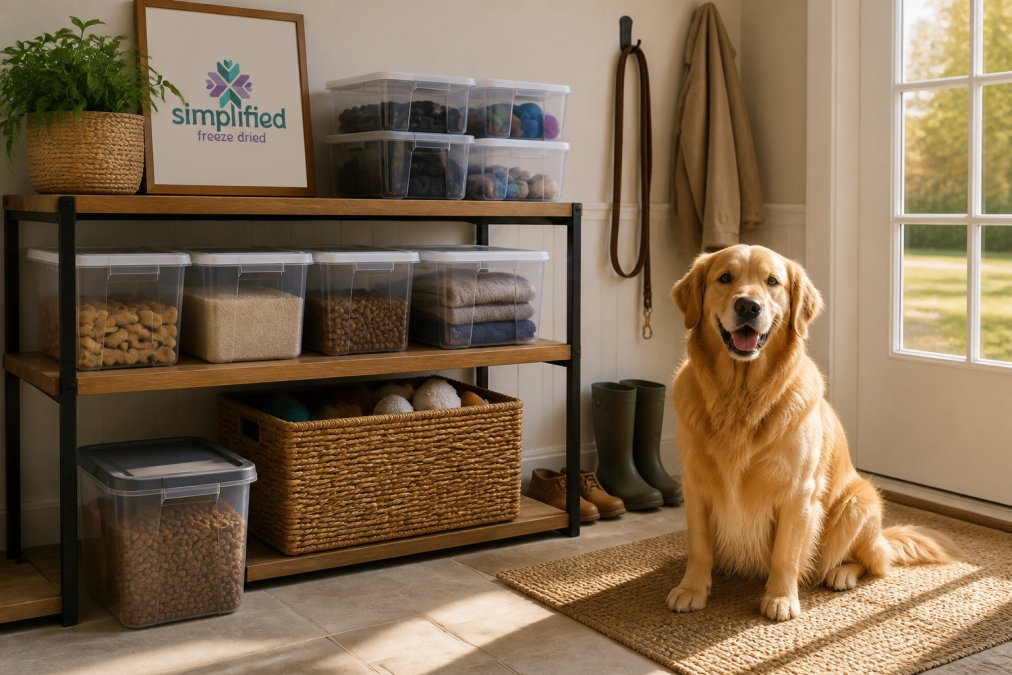
Build Zones by Function, Not by Product Type
Group supplies by when and where you use them, not by what they are. A feeding zone holds bowls, a sealed food bin, and a scoop. A training zone holds your treat pouch and mini-sized rewards. A grooming zone holds brushes, nail clippers, and shampoo. A travel zone holds the leash, harness, waste bags, and a collapsible bowl.
Simplified Freeze Dried Beef Liver →
Choose Containers That Match the Risk
Not every supply needs the same storage. Match the container to what the item can do if it fails:
- Food and treats: Airtight, food-grade containers with a gasket seal. Keep the original bag inside or tape the lot code to the lid so you can act fast if a recall is announced.
- Cleaning products: A locked cabinet or a high shelf, separate from food and treats. Pet-safe cleaners are still cleaners.
- Toys and chews: A rigid bin you can inspect. Soft-sided baskets hide split seams and chewed edges until they become a choking hazard.
- Medications and supplements: A dedicated, labeled box kept out of reach, with expiration dates facing up.
- Seasonal and backup gear: Collapsible storage is fine here, since these items aren't in daily rotation.
Run a Rotation System
A collection stays safe only if it gets audited. A simple two-pass system covers most households:
- Monthly quick check: Scan the food and treat bins for expiration dates, sniff test open bags, and pull any toy with a crack, split seam, or exposed squeaker.
- Twice-a-year deep reset: Empty every bin, wipe it down, check emergency supplies for expired food and dried-out wipes, and confirm vaccination records and microchip numbers are still current.
Keep a Running Inventory
You don't need an app. A single index card taped inside the cabinet door works: list what you have, the date you opened it, and the reorder threshold. When you finish a bag of treats, note it. This is how you avoid the two most common failures, running out of a daily essential and discovering a six-month-old bag of food in the back of the bin.
Store Treats Where You Train
Training rewards get used dozens of times a day, so they need to live where training happens, not in the pantry. A small pouch on a hook by the door keeps rewards within reach. For training, use our mini-sized pieces, which are sized right for quick rewards. Our regular-size pieces are for treats only, since they're too big for training sessions.
Age-Specific Supply Evolution: Puppies to Seniors
Most pet supply guides hand you one static list and never tell you to revise it. That's the gap: a collection that's safe for a puppy can be dangerous for a senior, and gear that works for an adult can be wrong for a teething puppy. Treat your collection as something that evolves on a schedule, not something you buy once.
The Four Life Stages and What Changes
Puppy and kitten (0-12 months). The dominant risk is chewing and swallowing. Everything in reach is a potential obstruction. Prioritize chew-safe toys sized larger than the pet's throat, crate training supplies, and small training rewards. For training, use our mini-sized pieces, which are sized right for quick rewards. Our regular-size pieces are for treats only, since they're too big for training sessions.
A Simple Review Cadence
You don't need to overhaul the collection constantly. A once-a-year review tied to your pet's birthday or adoption anniversary is enough to catch most problems. At each review, ask four questions:
- What has this pet outgrown physically?
- What has this pet outgrown behaviorally?
- What has worn out or become a hazard?
- What new need has appeared that nothing in the collection addresses?
Environmental Enrichment Evolves Too
Physical supplies are only half the picture. Puzzle feeders and scent games keep aging minds engaged when long walks become harder. For puppies, enrichment means supervised exploration and chew outlets. For adults, it means variety and challenge. For seniors, it means low-impact problem-solving that doesn't demand stamina they no longer have. Rotate enrichment items the same way you rotate toys, so nothing becomes stale or dangerous.
Frequently Asked Questions
What criteria should I use to evaluate the safety of pet supplies?
Look for non-toxic materials, clear labeling, and compliance with pet product safety standards. Check for small parts that could be chewed off, avoid sharp edges, and verify that fabrics and plastics are free from harmful chemicals. For treats, single-ingredient options reduce the risk of hidden allergens or fillers. Always read the ingredient list and contact the supplier if sourcing details are unclear.
How do I identify high-quality, single-ingredient pet treats?
A high-quality single-ingredient treat lists one item on the label, such as beef liver or pumpkin. It should have no binding agents, preservatives, or artificial flavors. Look for transparency about sourcing, like 100% American beef liver, and processing methods such as freeze-drying that preserve nutrients. The benefits of single-ingredient pet treats include easier allergy management and simpler portion control, especially for pets with food sensitivities.
How can I verify the sourcing of pet products before buying?
Ask the supplier directly where ingredients or materials come from. Reputable brands provide details like farm location, country of origin, and processing standards. For treats, confirm whether meat is human-grade and never denatured. For gear, ask about material testing and whether any recycled or non-toxic components are used. If a company cannot answer basic sourcing questions, treat that as a warning sign.
What are the most important safety standards for pet toys and accessories?
Focus on durability, non-toxic materials, and size appropriateness. Toys should have no small parts that can detach and become choking hazards. Avoid toys with sharp edges or loose strings. For accessories like collars and harnesses, check for sturdy hardware and adjustable fits. There are no universal US government standards for all pet toys, so rely on brand transparency and customer reviews to gauge real-world safety.