


Table of Contents
- What Makes a High-Value Treat for Training
- Dog Training Treat Size Guidelines
- The Timing and Delivery of Rewards
- Using Freeze-Dried Treats for Training
- Managing Treat Satiation and Fatigue
- How to Fade Out Food Rewards in Dog Training
- Common Mistakes With High-Value Treats
- Frequently Asked Questions
Last Updated: September 30, 2026
What Makes a High-Value Treat for Training
High-value treats positive reinforcement training uses are foods your dog finds irresistible. They're rewards so good that your dog will work harder to earn them than for regular kibble. The key difference between a high-value treat and a standard snack comes down to palatability and motivation.
A treat that excites your dog at home might lose appeal in a busy park. Understanding value hierarchy matters because a high-value treat should trigger immediate focus and enthusiasm, signaling that they've done something worth celebrating.
Freeze-dried treats preserve the natural smell and taste dogs crave without added flavors or binders. Simplified Freeze Dried's single-ingredient beef liver treats are nothing but whole food, freeze-dried to concentrate the flavors dogs love most.

The best high-value treats for training share these traits:
- Strong smell that captures attention immediately
- Single ingredient with no fillers or binding agents
- Easy to break into tiny pieces without crumbling
- Soft enough to swallow quickly so training flows
- Nutritionally dense so a small piece feels rewarding
Dog Training Treat Size Guidelines
Size matters because mini-sized pieces work best for training sessions, they allow rapid repetition without overfeeding and match your dog's size and the specific behavior you're training.
Big treats slow your training rhythm because your dog takes time to chew and you lose momentum. Mini-sized pieces let you reward instantly and move to the next repetition, keeping energy high and making learning stick faster.
Sizing by Dog Size and Mouth Proportions
For small dogs, mini-sized pieces are essential and proportional to mouth size. A treat comfortable for a 60-pound Labrador is a choking hazard for a Chihuahua. For larger dogs, keep pieces small enough to consume in one or two bites for immediate readiness for the next behavior.
Mini-sized pieces matter for rapid-fire sequences, each treat should be consumed in under two seconds to maintain the connection between behavior and reward.
The Behavior-Specific Value Hierarchy
Simple behaviors like sit or down in your living room need lower-value rewards, a kibble-sized mini piece works fine because competing motivations are minimal.
Moderate-difficulty behaviors like loose-leash walking need medium-value rewards. A mini-sized freeze-dried piece maintains engagement without causing early satiation.
High-difficulty behaviors or high-distraction environments demand high-value treats. Teaching reliable recall at a dog park or counter-conditioning fear responses requires treats your dog finds irresistible because the competition for attention is intense.
Reserve your highest-value treats for the hardest tasks and use lower-value rewards for easy wins. This keeps motivation fresh and prevents satiation from limiting session length.
Environmental Context and Treat Value
In low-distraction settings, smaller pieces maintain focus. In high-distraction environments like parks, use higher-value treats to compete for attention and redirect focus away from other dogs and smells.
Temperature affects treat value, in summer, strong-smelling treats become more valuable as appetite may lower; in winter, food drive is higher so lower-value rewards work.
Train before meals when your dog is hungry to use lower-value treats effectively, or use higher-value rewards after meals when food motivation is naturally lower.
Storage and Consistency
Freeze-dried treats stay fresh and don't create mess in your training pouch. Mini-sized freeze-dried pieces maintain their integrity and deliver consistent reward value, which accelerates learning.
Keep training treats separate from regular treats in a dedicated pouch. This signals to your dog that training time means something special is happening.
The Timing and Delivery of Rewards
You have roughly one to two seconds to mark and reward the correct behavior. Miss that window and your dog won't connect the treat to what they just did.
The marker signal, a clicker or verbal "yes", tells your dog exactly which behavior earned the reward. Without precise timing, you're rewarding random behavior instead of the specific action you wanted.
The Critical Difference: Luring vs. Rewarding
Luring means showing the treat before the behavior to guide your dog into position. Rewarding means delivering the treat after the behavior is complete. Using them at the wrong stage creates dependency.
Simplified Freeze Dried Beef Liver →
Early in training, luring helps your dog understand what you want. Over time, fade the lure by holding the treat closer to your body and rewarding only when your dog sits without seeing the treat first. This teaches your dog to offer the behavior on cue alone.
If you never fade the lure, your dog learns to work only when they see the treat. This is the difference between a dog that reliably obeys and one that only responds when motivated by visible rewards.
Delivery Mechanics: Hand Placement and Speed
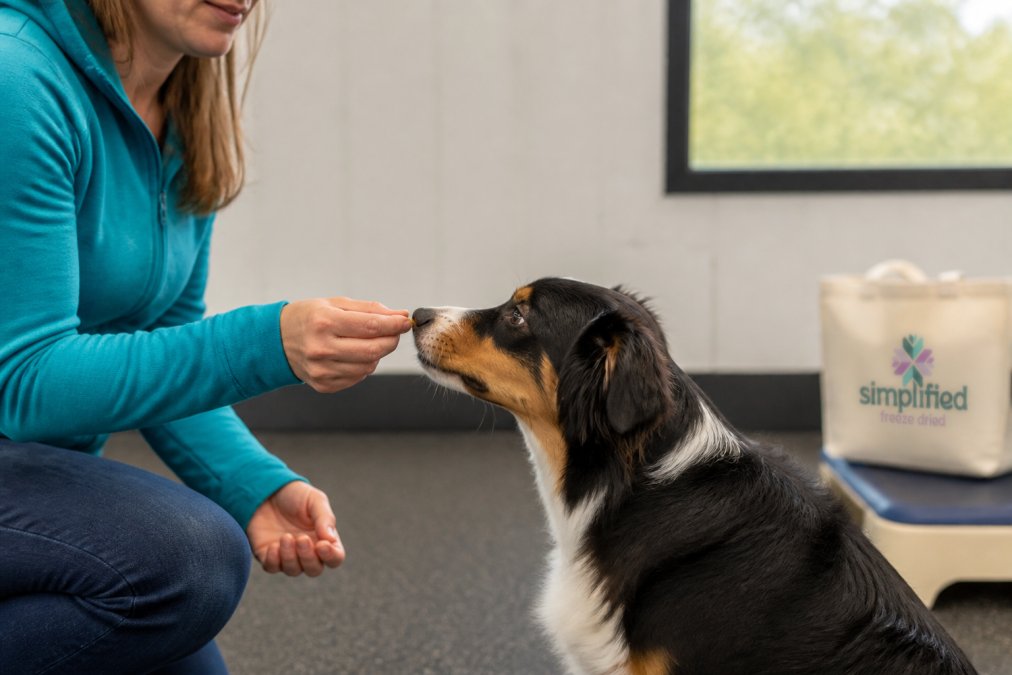
Hand-feeding treats creates stronger engagement than tossing them. Placing a treat directly into your dog's mouth builds the handler-dog connection that makes training efficient.
Deliver treats at nose level or slightly below to keep your dog's head in the right position for the next repetition. High delivery teaches jumping; low delivery teaches head level with yours.
Quick, confident hand delivery signals the reward is coming immediately. Slow delivery creates uncertainty and disengagement. Practice smooth, decisive delivery.
Tossing treats teaches dogs to look away and chase instead of maintaining focus on you. This works against handler engagement, especially in early training stages. Reserve treat tosses for specific scenarios, like rewarding recalls where you want your dog to chase the treat away from you, or for play-based rewards in advanced training. For foundational behaviors, hand delivery builds better attention and faster learning.
Consistency in Delivery Location
Consistency in delivery location trains your dog to anticipate rewards and return to you. They learn to come back after completing a behavior because they know that's where rewards happen. This creates a reinforcement loop that accelerates behavioral shaping and makes your training sessions more productive.
If you sometimes hand-feed and sometimes toss, your dog gets confused about where to look for the reward. They may start offering the behavior and then looking around uncertainly instead of returning to you. Decide on your delivery method early and stick with it until the behavior is solid. Then you can introduce variety once your dog understands the core behavior.
Using Freeze-Dried Treats for Training
Freeze-dried treats deliver concentrated nutrition and flavor in a lightweight package. The freeze-drying process removes water while keeping nutrients intact. This means a small piece packs the reward value of a much larger treat.
Freeze-dried options work across all training scenarios. They don't require refrigeration, won't spoil in your training pouch, and create zero mess. Unlike fresh meat or soft treats that leave residue on your hands, freeze-dried treats keep your training space clean and your focus on the dog.
Single-ingredient freeze-dried treats are ideal for dogs with food sensitivities. If your dog has chicken allergies or digestive issues, you know exactly what they're eating. Simplified Freeze Dried uses 100% American beef liver with no additives, fillers, or denatured meat. Every piece is human-grade quality and minimally processed, cut once then freeze-dried to preserve maximum nutrition.
The palatability of freeze-dried treats makes them perfect for counter-conditioning and desensitization work, where high-value treats positive reinforcement becomes essential to compete with emotional reactions. When you're teaching a dog to stay calm around triggers, the treat value needs to be high enough to compete with the emotional reaction. Freeze-dried treats often win that competition because the smell and taste are so concentrated.
Pumpkin puree offers another single-ingredient option for dogs who need variety or have beef sensitivities. Simplified Freeze Dried's freeze-dried pumpkin biscuits use 100% American pumpkin sourced from the Midwest. They provide the same training benefits as protein-based treats with a different flavor profile.

Managing Treat Satiation and Fatigue
Satiation is the point where your dog loses interest in the reward. It happens when they've eaten enough or when a treat becomes too familiar. Understanding satiation prevents training plateaus and keeps sessions productive.
Your dog's food drive changes throughout the day.
How to Fade Out Food Rewards in Dog Training
Fading food rewards doesn't mean stopping reinforcement entirely. It means transitioning from constant treat rewards to intermittent reinforcement. This teaches your dog to work reliably even when treats aren't guaranteed.
Common Mistakes With High-Value Treats
Using treats that are too large is the most common training mistake. Big treats slow your training pace and create inconsistent reward timing. They also lead to overfeeding during training sessions. Mini-sized pieces solve this problem entirely.
Frequently Asked Questions
What qualifies as a high-value treat for dog training?
A high-value treat is something your dog finds irresistible, typically novel, aromatic, or more flavorful than everyday kibble. Single-ingredient freeze-dried treats like beef liver work well because they have intense palatability and aroma that captures attention even in distracting environments. The value depends on your individual dog, what excites one dog may not motivate another. Test different options during low-distraction sessions first to identify what truly drives your dog's engagement.
Can you use too many high-value treats during training sessions?
Yes. Overusing high-value treats leads to satiation, where your dog loses interest because their food drive is satisfied. It also inflates daily calorie intake and can create treat fatigue. Most trainers recommend limiting high-value treat sessions to 10-15 minutes per day, using only mini-sized pieces for each reward. This keeps motivation high while maintaining nutritional balance. Rotate between different treat types to prevent palatability fatigue.
How do you transition from high-value treats to lower-value rewards?
Gradual transition is key to sustained behavioral change. Once your dog reliably performs a behavior with high-value rewards, begin mixing in lower-value treats (like regular kibble) on an intermittent reinforcement schedule. Reward the best performances with high-value treats and adequate performances with lower-value rewards. Slowly increase the ratio of low-value to high-value over weeks. Eventually, introduce non-food rewards like praise, play, or toys. This prevents dependence while maintaining the behavior.
Why are single-ingredient freeze-dried treats better for positive reinforcement training?
Single-ingredient treats eliminate hidden additives, preservatives, and binding agents that can trigger digestive upset or allergic reactions in sensitive dogs. Freeze-drying preserves nutrients and natural palatability without adding fillers, making them more motivating during training. For dogs with food sensitivities or allergies, single-ingredient options like Simplified Freeze Dried beef liver treats reduce the risk of adverse reactions while delivering high food drive. This reliability means you can confidently use them across multiple training sessions without worry.
Training with high-value treats works because dogs understand immediate cause and effect. The right reward at the right moment teaches faster than any other method. Simplified Freeze Dried's single-ingredient freeze-dried treats are designed for this exact purpose, they deliver the reward value and consistency your dog needs to learn reliably. Start with mini-sized pieces, focus on timing, and watch your training progress accelerate.