


Table of Contents
- What Freeze-Dried Cat Treats Actually Are
- Freeze-Dried Beef Liver for Cats: Nutritional Profile
- Are Freeze-Dried Treats Really Low-Calorie?
- Low-Calorie Cat Treats for Weight Loss: How They Fit Into a Diet Plan
- Safe Treat Portions for Cats: The 10% Rule and Beyond
- Treats Versus Complete and Balanced Cat Food
- Calculating Your Cat's Individual Treat Calorie Budget
- Conclusion
- Frequently Asked Questions
Last Updated: October 8, 2026
What Freeze-Dried Cat Treats Actually Are
Freeze-dried cat treats are whole-food snacks that are frozen, then had moisture removed through a specialized process, leaving concentrated nutrition in a lightweight, shelf-stable form. Unlike traditional treats that rely on binders, fillers, or preservatives, quality freeze-dried options contain single ingredients, often just beef liver, chicken, or pumpkin, which is why many ask are freeze dried cat treats healthy for weight loss, and the answer lies in their clean ingredient profile and suitability for cats with food sensitivities.
The freeze-drying process sets these treats apart. Fresh meat or produce is frozen solid, then placed in a vacuum chamber where ice crystals sublimate directly into vapor without passing through a liquid state. This preserves the nutritional structure, enzymes, and natural flavors in ways heat-based processing cannot match, and the result rehydrates quickly when a cat chews it.
At Simplified Freeze Dried, we focus on single-ingredient freeze-dried options. Our beef liver treats contain nothing but beef liver, no added binders, no hidden ingredients, no processing aids. When evaluating freeze-dried treats for weight loss or general health, understanding this structure helps you read labels critically and spot products that hide fillers under vague ingredient lists.

For weight-conscious cat owners, freeze-dried treats are calorie-dense but portion-controlled by nature: a small piece delivers satisfying flavor.
Freeze-Dried Beef Liver for Cats: Nutritional Profile
Beef liver is one of the most nutrient-dense foods available for cats, and freeze-drying concentrates that density further. A single freeze-dried beef liver treat contains high-quality animal protein, B vitamins (particularly B12), iron, and other micronutrients. Because moisture is removed, nutritional value per gram is significantly higher than fresh liver.
Cats are obligate carnivores, built to extract and use animal-based proteins and fats, and beef liver aligns perfectly with this biology. Crude protein in freeze-dried beef liver typically ranges from 60-80% on a dry-matter basis, far exceeding most commercial cat foods, so cats feel satisfied with smaller portions.
Fat content also matters for weight loss. Beef liver contains fat (usually 10-20% on a dry-matter basis), but total fat per treat stays low because serving sizes are small. A single freeze-dried piece weighs a fraction of a gram, so absolute fat intake is negligible.
Some owners worry freeze-dried beef liver is too rich or upsets sensitive digestive systems. In practice, freeze-drying removes water without altering protein structure in ways that increase digestibility problems. If a cat tolerates fresh beef liver, freeze-dried liver from the same source will typically be well-tolerated. Introduce any new treat gradually.
Are Freeze-Dried Treats Really Low-Calorie?
The truth is more nuanced than "freeze-dried equals low-calorie."
Freeze-dried treats are calorie-dense by weight. Because water is removed, caloric concentration per gram is high, sometimes higher than the fresh ingredient. A freeze-dried beef liver treat might contain calories per piece, while a fresh piece of the same weight would contain fewer due to water content.
The practical question for weight loss is total calories per serving, not density per gram. A single freeze-dried beef liver treat weighs less than one gram, so even at high caloric density it contributes minimal calories. Three to five treats per day is manageable within a weight-loss plan.
Confusion arises when owners compare treat categories by label without considering portion size. A label might show calories per treat, but if "one treat" is a 2-gram piece, the math changes. Simplified Freeze Dried's pieces are portion-controlled from the start, small enough for training rewards without overfeeding.
The real advantage is behavioral, not purely caloric. Cats seeking enrichment, attention, or reward respond to freeze-dried treats because the flavor is intense and the texture is novel. You can satisfy a cat's need for a "treat" with a piece so small it barely registers calorically, unlike a larger traditional treat with added fats or carbohydrates that still leaves the cat wanting more.
Low-Calorie Cat Treats for Weight Loss: How They Fit Into a Diet Plan
Weight loss in cats depends on total caloric intake relative to energy expenditure. Treats are one variable, not the whole story: a cat can gain weight on low-calorie treats if the main diet is oversized, or lose weight on regular treats if the overall plan is disciplined.
The 10% rule is the starting point for most veterinary guidance: treats should comprise no more than 10% of a cat's daily caloric intake, with 90% from complete and balanced cat food.
Freeze-dried treats make this easy because you control portion size precisely. Three to five small pieces per day fits comfortably within the 10% window, providing satisfaction and reward.
Freeze-dried treats are genuinely useful for replacing higher-calorie alternatives. If you previously offered commercial treats with corn, wheat, or added fats, switching to single-ingredient freeze-dried options reduces caloric intake while maintaining the behavioral reward. The cat still gets a "treat," but the profile is cleaner and the calorie cost lower.
Freeze-dried treats also work well as training rewards. Many owners use treats to reinforce behaviors like coming when called, using the scratching post, or accepting nail trims. Our mini-sized pieces are designed for this, allowing frequent positive reinforcement at minimal caloric cost without portion creep. The regular size pieces are for treats only, too big for training.
Safe Treat Portions for Cats: The 10% Rule and Beyond
The 10% treat guideline is a ceiling, not a target. Many cats thrive on fewer treat calories, especially overweight cats working toward weight loss.
To calculate your cat's treat budget, start with their daily caloric requirement. An average 10-pound adult indoor cat needs roughly 180-200 calories per day, varying by age, activity, metabolism, and weight status.
Multiply the daily caloric target by 0.10 to find maximum treat calories.
Freeze-dried treats make budgeting straightforward. A 20-calorie budget allows five pieces per day; three pieces leaves a 5-calorie margin for other shared food.
Simplified Freeze Dried Beef Liver Treats for Dogs & Cats →
Measure portions consistently: use the same treat, count the pieces, and log them if tracking a weight loss plan. Consistency matters more than perfection. Four treats Monday, three Tuesday, and five Wednesday is still within safe limits if the main diet is appropriate.
One caution: freeze-dried treats should not be the only enrichment a cat receives. Cats benefit from play, environmental enrichment, and attention. If treats become the sole interaction, a cat may develop treat-seeking behaviors that undermine weight loss goals.
Treats Versus Complete and Balanced Cat Food
Complete and balanced cat food, whether wet, dry, or raw, contains all the amino acids, vitamins, minerals, and fats a cat needs. These foods meet AAFCO (Association of American Feed Control Officials) standards defining nutrient profiles for different life stages.
Treats are supplemental, not formulated as a sole diet. A cat could theoretically survive on freeze-dried beef liver alone, but doing so would create deficiencies over time: liver is low in taurine (an amino acid cats cannot synthesize), low in certain minerals, and lacks the balanced fat profile of a complete food.
This is why treats stay capped at 10% of daily intake. The other 90% must come from a complete and balanced diet ensuring adequate taurine, arachidonic acid, vitamin A, and other feline-specific nutrients.
For weight loss, the main diet is the primary lever. A cat fed unlimited complete food will gain weight regardless of treat control; a cat fed an appropriate portion will lose weight even if treats are slightly generous. Treats are a modifier, not the foundation.
For a weight-loss plan, look for foods labeled "weight management" or "indoor formula," typically lower in calories and fat. Pair these with freeze-dried treats used strategically for training or reward.
Calculating Your Cat's Individual Treat Calorie Budget
Here's how to determine how many freeze-dried treats your cat can safely receive while losing weight.
Step 1: Determine your cat's target daily calories. Consult your veterinarian for the specific target. A typical starting point is 10-12 calories per pound of ideal body weight; a 10-pound ideal weight means 100-120 calories per day.
Step 2: Calculate 10% of that total. Multiply your cat's daily caloric target by 0.10. This is your maximum treat budget. For a 200-calorie diet, that's 20 calories. For a 150-calorie diet, that's 15 calories.
Step 3: Know the calories per treat. Check the nutrition label on your freeze-dried treats. Most single-ingredient freeze-dried options contain 3-5 calories per piece, depending on size. Simplified Freeze Dried's beef liver treats are designed as small, portion-controlled pieces suitable for this calculation.
Step 4: Divide your budget by calories per treat. If your budget is 20 calories and each treat is 4 calories, you can offer five treats per day. If your budget is 15 calories and each treat is 3 calories, you can offer five treats.
Step 5: Distribute treats throughout the day. Rather than offering all treats at once, spread them across the day as rewards or enrichment. This maintains the cat's interest and prevents the sensation of deprivation.
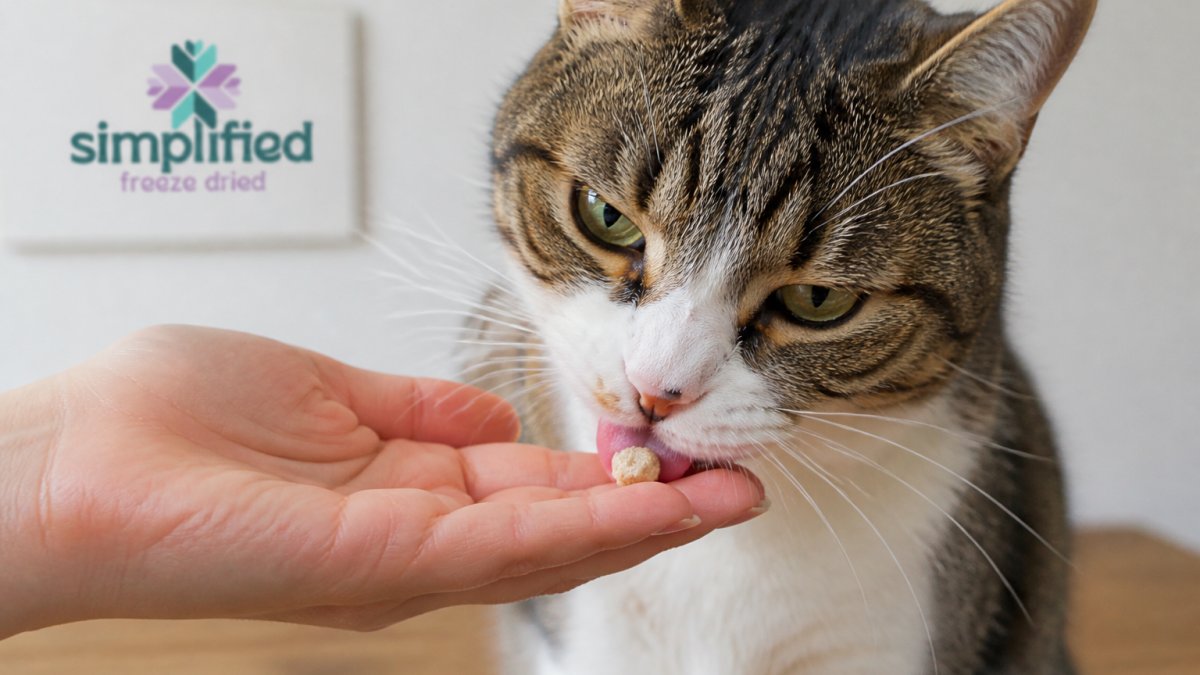
Step 6: Monitor weight loss progress. Weigh your cat weekly or biweekly. Healthy weight loss is typically 1-2% of body weight per week. A 10-pound cat should lose roughly 0.1-0.2 pounds per week.
This calculation removes guesswork. You're not estimating or hoping treats don't sabotage the diet, you're working within a clear budget that supports the weight loss goal.
| Step | Action | Result |
|---|---|---|
| 1 | Determine target daily calories | e.g., 150 calories |
| 2 | Calculate 10% | e.g., 15 calories max for treats |
| 3 | Check calories per treat | e.g., 3-4 calories each |
| 4 | Divide budget by calories per treat | e.g., 4-5 treats per day |
| 5 | Distribute throughout day | Spread treats as rewards |
| 6 | Monitor weekly weight loss | Adjust if progress stalls |
Conclusion
Freeze-dried cat treats can absolutely support weight loss, the question of whether are freeze dried cat treats healthy for weight loss is answered by their ability to allow precise portion control and satisfy behavioral reward needs at minimal caloric cost. The key is understanding that freeze-dried treats are calorie-dense per gram but portion-controlled by design, meaning a single piece delivers flavor and satisfaction without derailing a diet.
Are freeze-dried cat treats healthy for weight loss? Yes, when used correctly within the 10% treat guideline and paired with a complete, appropriately-portioned diet. The real work of weight loss happens in the main diet, but freeze-dried treats make it easier to stick to a plan because they provide reward and enrichment without the caloric burden of traditional alternatives.
Sustainable weight loss in cats requires veterinary oversight, consistent feeding discipline, and the right tools to maintain that discipline. At Simplified Freeze Dried, we've built our beef liver treats to support exactly this approach, single-ingredient nutrition, portion-controlled pieces, and the transparency to know exactly what your cat is eating. Our 100% American beef liver is minimally processed to preserve maximum nutrition, giving your cat the most nutrient-dense reward per calorie. Start with our beef liver treats as part of a structured weight loss plan, and track progress weekly to ensure your cat reaches a healthy weight safely.
Frequently Asked Questions
Is it safe to feed beef liver to my cat?
Yes, beef liver is safe for cats when offered as an occasional treat. Freeze-dried beef liver retains all nutrients from the raw ingredient while eliminating moisture and pathogens through the freeze-drying process. Single-ingredient freeze-dried beef liver contains no additives, binders, or preservatives. Always introduce new treats gradually and monitor your cat for any digestive upset. If your cat has existing health conditions, consult your veterinarian before adding treats to their diet.
How many freeze-dried treats should a cat have per day for weight loss?
Treats should not exceed 10% of your cat's daily caloric intake, regardless of weight-loss goals. Work with your veterinarian to establish a specific treat budget based on your cat's current weight, target weight, and overall calorie needs.
Are freeze-dried treats lower in calories than traditional cat treats?
Freeze-dried treats are often lower in calories per piece than soft or crunchy commercial treats because freeze-drying removes water weight while preserving the nutrient density of the original ingredient. Single-ingredient freeze-dried beef liver contains primarily protein and fat with minimal carbohydrates, making it calorie-dense by weight but portion-controlled by piece count. Compare labels carefully.
Can freeze-dried treats help with feline weight management?
Freeze-dried treats can support weight management when used correctly as part of a controlled calorie plan. Their high protein content and low carbohydrate profile satisfy your cat's natural carnivorous appetite without excess calories. The key is portion control and accounting for treat calories within your cat's daily limit. Weight loss depends primarily on overall calorie reduction and increased activity, not the treat type itself. Veterinary supervision is essential for safe, sustainable weight loss in cats, especially to prevent hepatic lipidosis.