


Table of Contents
- Why Buying Safe Pet Products Online Requires Extra Care
- How to Read Pet Food Labels Before You Buy
- How to Spot Fake Pet Product Reviews
- The Benefits of Single-Ingredient Pet Treats for Sensitive Pets
- Choosing Healthy Training Rewards for Dogs and Cats
- Secure Checkout and Data Privacy When Shopping Online
- Tracking Recalls and Verifying Sustainable Sourcing
- Conclusion
- Frequently Asked Questions
Last Updated: September 12, 2026
Why Buying Safe Pet Products Online Requires Extra Care
Buying safe pet products online means verifying ingredients, sellers, and payment security before a single treat ships. It's harder than it sounds. A product page can look flawless while hiding filler ingredients, a seller with no traceable history, or a checkout page that puts your card details at risk.
This guide from Simplified Freeze Dried walks through the exact checks we'd want a pet parent to run before clicking "buy": reading labels, spotting fake reviews, choosing healthy training rewards, and keeping your payment data locked down.
The stakes are real. The FDA's guidance on pet food safety makes clear that pet food falls under the same federal safety expectations as human food in key respects, which means sellers who cut corners are breaking rules, not just disappointing you. The FTC's guidance on online shopping and impostor scams also notes that online shopping fraud remains one of the most reported consumer complaints, and pet product listings are not immune.
Below, we break down nine practical checks, from label reading to recall tracking, so you can shop with confidence instead of hope.
How to Read Pet Food Labels Before You Buy
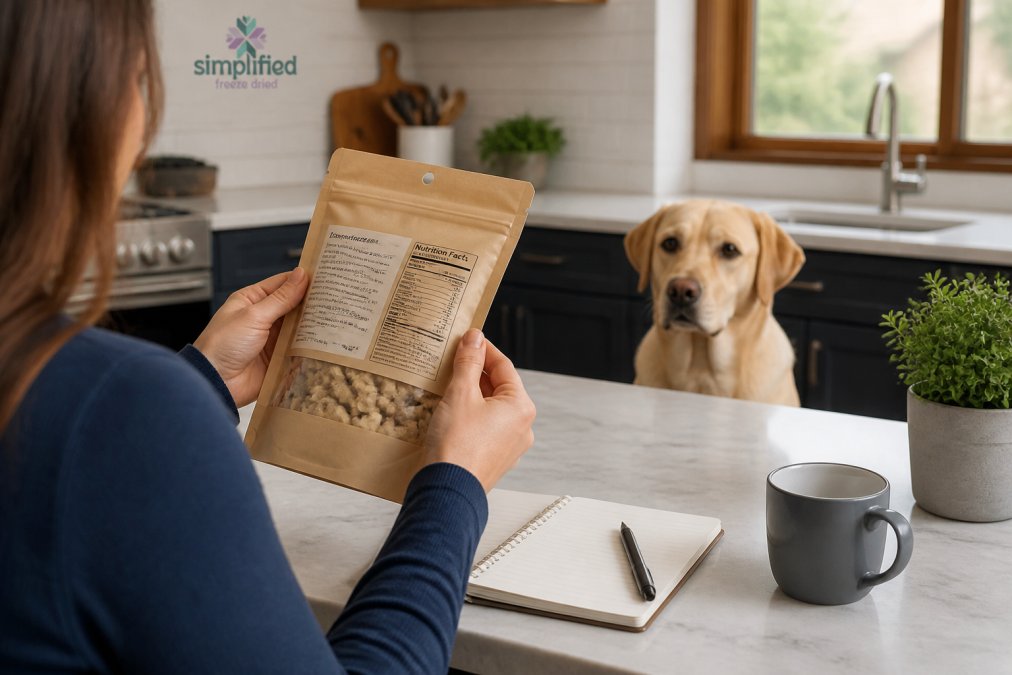
Reading a pet food label means scanning the ingredient list first, then the guaranteed analysis, then the certification claims, in that order. Most shoppers do it backwards, trusting the front of the package before the fine print.
Start here:
- Ingredient order matters. Ingredients are listed by weight, so the first three items tell you what the product mostly is.
- Watch for splitting. A manufacturer can list "chicken, chicken meal, chicken fat" separately to push a filler higher up the list.
- Check the guaranteed analysis. Protein, fat, and fiber percentages should match what the front label promises.
- Look for a named protein source. "Beef liver" beats "meat by-products" every time.
Red Flags in Ingredient Lists
Red flags include vague protein sources, artificial dyes, and preservatives you can't pronounce. "Meat meal," "animal digest," and "by-product meal" tell you nothing about which animal or which part. Artificial colors like Red 40 and Yellow 5 exist for human eyes, not pet health. And if the label lists "BHA," "BHT," or "ethoxyquin," that's a signal the product is built for shelf life, not nutrition.
The cleanest labels list one or two ingredients, full stop. That's the entire point of a single-ingredient treat: there's nothing to hide behind.
Understanding Certifications and Third-Party Testing
Certifications only mean something when a third party, not the manufacturer, does the testing. Look for statements like "made in a facility inspected by [agency]" or references to AAFCO nutrient profiles, which set the standard many states use for pet food labeling. A brand that publishes its sourcing and testing process is telling you it has nothing to hide. A brand that only says "premium" or "natural" on the bag is telling you nothing at all.
How to Spot Fake Pet Product Reviews
Fake reviews follow patterns. Once you know them, they're easy to catch in under a minute.
- Timing clusters. Ten five-star reviews posted in two days is a red flag, not a coincidence.
- Generic praise. "Great product, fast shipping!" with no detail about the actual item usually means the reviewer never opened it.
- No verified purchase badge. On most platforms, reviews without a verified purchase tag carry far less weight.
- Perfect ratings with zero photos. Real pet owners post pictures of their dogs and cats. Bots don't.
- Reviewer history. Click the reviewer's profile. If every review is five stars across unrelated categories, you're looking at a farm.
Cross-check reviews on more than one site. A product with 4.8 stars on the seller's own page but no independent mentions anywhere else deserves skepticism.
The Benefits of Single-Ingredient Pet Treats for Sensitive Pets
Single-ingredient treats remove the guesswork for pets with allergies or food sensitivities. When there's only one ingredient, there's only one thing that could trigger a reaction, which makes elimination diets and allergy tracking dramatically simpler.
For pets with chicken allergies, for example, a treat made from 100% beef liver means you're not decoding a ten-item ingredient list to figure out what caused the itching. The FDA's pet food recall database is a useful tool here too: it lets you check whether a specific product or brand has a history of contamination issues before you buy.
Simplified Freeze Dried builds its entire product line around this idea. Every treat is single-ingredient, freeze-dried fresh, and made with 100% American beef liver or 100% American pumpkin. No imported beef, no denatured meat, no fillers. For a pet with a sensitive stomach, that simplicity is the whole value proposition.
Choosing Healthy Training Rewards for Dogs and Cats
Healthy training rewards should be small, single-ingredient, and easy to break apart without making a mess. Training sessions involve repetition, which means your pet might eat ten or fifteen rewards in a single sitting. Whatever you're using needs to hold up to that volume without wrecking their diet.
Here's a quick framework for picking the right reward:
| Training Scenario | Best Treat Type | Why It Works |
|---|---|---|
| Puppy basic commands | Kibble-sized single-ingredient pieces | Fast to eat, keeps sessions moving |
| Cat clicker training | Small freeze-dried protein pieces | Cats respond to high-value protein |
| Allergy-sensitive pet | Single-ingredient, no fillers | Removes trigger guesswork |
| Long training session | Small pieces, low calorie density | Prevents overfeeding during repetition |
Size Matters: Why Small Pieces Work Best for Training
Small pieces work best because training depends on speed and repetition, not volume. A treat that takes thirty seconds to chew breaks the rhythm of the session and lets your dog lose focus. A kibble-sized piece delivers the reward instantly so you can move to the next repetition.
This is why Simplified Freeze Dried offers mini-sized pieces built specifically for training. The regular-size pieces are treats, not training rewards, because they're simply too big to hand out fifteen times in a row. Using the right size keeps your training sessions sharp and your pet's calorie intake reasonable.
Secure Checkout and Data Privacy When Shopping Online
Secure checkout starts with two things: an encrypted connection and a payment method that doesn't expose your primary bank account. But the deeper risk most pet-product guides ignore isn't the checkout page itself, it's the fake store built to look like one. A lookalike site can clone a real pet retailer's logo, product photos, and even its return policy, then harvest your card number and shipping address at a checkout that never ships anything.
Before you enter card details anywhere, run these checks:
-
Confirm the domain character by character. Lookalike stores swap letters (
chewyvs.chewv), add hyphens, or use a different top-level domain than the brand's real site. Type the brand's name into a search engine and click the official result rather than trusting a link from an email, text, or social ad. - Check that the site uses HTTPS and that the checkout is hosted by a recognized payment processor. An HTTPS padlock means the connection is encrypted; it does not mean the seller is legitimate. A checkout that redirects to a processor you recognize is a stronger signal than a padlock alone.
- Use a credit card, not a debit card. Credit cards offer stronger fraud protection under federal law, and a disputed charge doesn't drain your checking account while it's investigated.
- Turn on two-factor authentication for any account you create with a retailer, so a stolen password alone can't unlock your order history or saved addresses.
- Avoid saving card details on unfamiliar sites, even when the site offers it. Saved cards are convenient on retailers you buy from monthly and a liability on a store you found last week.
- Watch for phishing emails that mimic order confirmations and ask you to "verify" payment info. Legitimate retailers don't ask you to re-enter a full card number by email.
What Your Data Is Worth to a Bad Actor
Pet-owner accounts are attractive targets because they often hold a name, home address, phone number, and a saved payment method, a bundle that's easy to resell or reuse for follow-up phishing. That's why data privacy is part of product safety, not a separate concern. When you create an account, check the site's privacy policy for whether it sells or shares your information with third parties, and use a unique password you don't reuse on your email or banking accounts. If a retailer suffers a breach, a reused password is how one compromised pet-store login turns into a compromised inbox.
Returns and Refunds as a Security Signal
A clear, specific return policy is a trust indicator. A legitimate retailer states its return window, who pays return shipping, and how refunds are issued. A store with no return policy, or one buried behind a contact form that never answers, is a store you can't hold accountable if the product arrives damaged, expired, or not at all. Read the policy before you buy, especially for consumable items like treats, where opened packages are often non-returnable.
A secure payment gateway and data encryption aren't optional extras. They're the baseline for any retailer you hand your card to, and the checks above take about two minutes before your first order.
Tracking Recalls and Verifying Sustainable Sourcing
Recall tracking and sourcing verification are the two checks most shoppers skip, and they're the two that catch problems before they reach your pet. The difference between a casual check and a real system is automation: a recall you learn about three weeks late is a recall your pet already ate through.
Set Up Recall Alerts So You Don't Have to Remember
Manual checking works until you forget. Build a system instead:
- Bookmark the FDA's recall and withdrawal notices page and check it whenever you buy from a new brand. This is the master list for pet food and treat recalls.
- Sign up for manufacturer email alerts. Brands that issue recalls notify subscribers directly, and recalls move fast, direct notification beats waiting for news coverage.
- Follow the FDA's pet food recall RSS feed or email subscription if you want a single stream covering every brand rather than signing up store by store.
- Save the lot number from each package. If a recall is ever issued, that number tells you instantly whether your specific batch is affected, rather than forcing you to throw out everything you bought.
- Keep a running list of the brands and products your pet eats regularly. When a recall hits, you can scan your list in seconds instead of trying to remember what's in the pantry.
Verify Sourcing With Specifics, Not Slogans
"Sustainably sourced" means nothing on its own. "100% American beef liver, sourced from Midwest farms" tells you exactly where the product came from and gives you something to verify. When you're evaluating a brand's sourcing claims, look for:
- A named origin. Country or region of origin is verifiable; "premium ingredients" is not.
- A named supplier or farm network. Brands proud of their supply chain usually name it.
- A published testing process. Third-party testing, facility inspections, and batch testing results are the difference between a claim and a commitment.
- Consistency across the product line. If one product names its source and another hides behind vague language, the transparency is marketing, not practice.
Brands that name their region and their ingredient origin are usually brands that are proud of both. When a brand won't tell you where an ingredient comes from, that silence is the answer.
Put It Together
Recall alerts protect the products you've already bought; sourcing verification protects the products you're about to buy. Run both, and you've closed the two gaps that let a bad batch reach your pet's bowl.
Conclusion
Buying safe pet products online comes down to a handful of habits: read the label before the marketing copy, check reviews across multiple sites, use a secure payment method, and track recalls for anything your pet eats regularly. None of it takes more than a few minutes per purchase.
Simplified Freeze Dried was built for pet parents who want that verification to be simple. Every treat is single-ingredient, freeze-dried fresh, and made with 100% American beef liver or pumpkin from Midwest farms, with mini-sized pieces designed specifically for training and regular pieces for treating. Get started with Simplified Freeze Dried and give your pet a reward you can actually trace back to the source.
Frequently Asked Questions
How can I verify if an online pet store is legitimate?
Check for a secure checkout with HTTPS and a padlock icon. Look for a physical address and phone number on the site. Search the business name with 'scam' or 'complaint' to see if others have reported issues. Read verified reviews on independent platforms, not just the store's own site. Legitimate sellers, like Simplified Freeze Dried, provide clear contact information and a return policy. If a deal seems too good to be true, it often is.
What should I look for on a pet product ingredient label?
Look for a short, recognizable ingredient list. For treats, single-ingredient options like freeze-dried beef liver are ideal. Avoid artificial dyes, BPA, phthalates, and vague terms like 'meat meal' or 'by-products.' Check for third-party testing seals or certifications. The label should list the manufacturer and provide a way to contact them. If you can't find sourcing details, that's a red flag.
How do I avoid counterfeit pet products online?
Buy directly from the manufacturer or authorized retailers. Counterfeit goods often appear on third-party marketplaces. Check packaging for typos, poor print quality, or missing lot numbers. Verify the seller's reputation and read reviews for mentions of authenticity. For freeze-dried treats, look for brands that clearly state their sourcing, like 100% American beef liver. If the price is significantly lower than other sellers, be suspicious.
What are the benefits of single-ingredient pet treats?
Single-ingredient treats reduce the risk of allergic reactions because there are no hidden fillers, preservatives, or binding agents. They're easier to digest, especially for pets with food sensitivities. For training, they offer high value without unnecessary calories. Brands like Simplified Freeze Dried use 100% human-grade beef liver, minimally processed to retain nutrients. This transparency makes it easier to know exactly what your pet is eating.