


Table of Contents
- Why Limited-Ingredient Treats Help Cats With Food Sensitivities
- How to Read Cat Treat Ingredients Like a Label Detective
- Single Ingredient Cat Treats: The Simplest Label You Can Buy
- Are Hypoallergenic Cat Treats Really Hypoallergenic?
- Food Allergy vs. Food Intolerance: Why the Difference Matters
- Choosing Cat Treats for Sensitive Stomachs
- Picking Treats During an Elimination Diet
- Conclusion
- Frequently Asked Questions
Last Updated: October 19, 2026
Why Limited-Ingredient Treats Help Cats With Food Sensitivities
Limited-ingredient treats for cats with food sensitivities solve a simple problem: fewer ingredients means fewer chances for a reaction.
At Simplified Freeze Dried, we built our entire catalog around that idea. Every treat we make starts with one whole ingredient and nothing else.
Below, we walk through how to read a label, why single-ingredient treats are the safest starting point, and how to pick treats during an elimination diet without derailing the results.
How to Read Cat Treat Ingredients Like a Label Detective
The first rule of reading a cat treat label is to ignore the front of the bag and go straight to the ingredient panel. The front is marketing. The panel is fact.
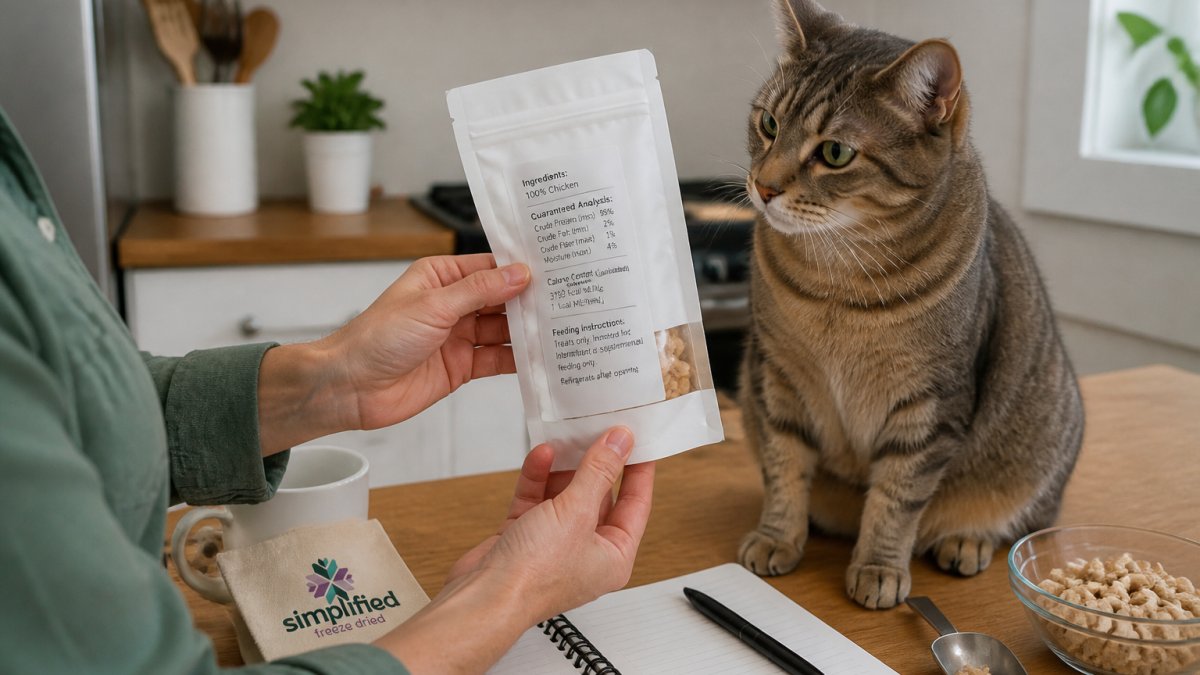
Ingredients are listed by weight, so the first few items tell you most of the story. A treat that lists chicken first, then chicken meal, then chicken fat is a chicken treat no matter what the flavor name says.
Look for these red flags on any treat bag:
- Multiple proteins in one treat. Hard to isolate what caused a reaction.
- Unnamed "meat" or "animal by-products." You cannot track a protein you cannot name.
- Added binders, fillers, or preservatives. More ingredients, more variables.
- Vague terms like "natural flavor." This can hide a protein source.
A treat with a one-word ingredient list is the easiest label to verify. You read one word, you know exactly what your cat is eating.
Single Ingredient Cat Treats: The Simplest Label You Can Buy
Single ingredient cat treats contain exactly one food item and nothing else. No binders, no preservatives, no flavoring, no second protein hiding in the mix. For a cat with a known sensitivity, that is the cleanest starting point you can buy.
Our freeze-dried beef liver treats are a single ingredient: 100% American beef liver, human-grade, cut once and freeze-dried. No imported beef, no denatured meat. Our pumpkin biscuits are the same idea with 100% American pumpkin.

That simplicity matters for two reasons. First, you can rule an ingredient in or out without guessing.
Are Hypoallergenic Cat Treats Really Hypoallergenic?
Hypoallergenic cat treats are treats formulated to reduce the chance of an allergic reaction, usually by using a novel protein or a limited ingredient list.
A treat can call itself hypoallergenic and still contain a protein your cat has eaten for years. "Hypoallergenic" means lower risk in general terms, not safe for your specific cat.
That is why we lean on transparency instead of labels. A one-ingredient treat does not need a hypoallergenic claim, because there is nothing to hide behind. You can see the entire formula in a single word.
Food Allergy vs. Food Intolerance: Why the Difference Matters
A food allergy is an immune system reaction to a protein, while a food intolerance is a digestive problem that does not involve the immune system.
Allergies often show up as skin irritation, itchiness, or inflammation, sometimes alongside digestive upset. Intolerances tend to show up as gastrointestinal trouble: loose stool, gas, or vomiting after eating a specific food. An allergy can worsen over time with repeated exposure.
Why does this matter for treats? Because the fix is different. For an intolerance, you can often manage the problem by reducing or removing the trigger.
Choosing Cat Treats for Sensitive Stomachs
Cat treats for sensitive stomachs should be short on ingredients, easy to digest, and free of the fillers that tend to cause trouble. A short ingredient list is the single best filter you have, but it is only the first filter. The sections below turn that filter into a repeatable selection process you can apply to any bag on the shelf.
The five-filter checklist
Here is the checklist we would use to evaluate any treat for a sensitive cat:
- One protein or one whole food. No blends, no "meat" catch-alls, no second protein hiding behind a flavor name.
- No grain, no filler, no added sugar. Fewer ingredients to react to, and fewer variables to isolate if something goes wrong.
- A protein your cat has not eaten before, or one you know is safe. Novel proteins help when you are starting fresh; a known-safe protein helps when you are mid-trial.
- A texture your cat will actually eat. A treat that gets refused helps no one, and a refused treat can tempt you to try something off-plan.
- Clear sourcing. You should be able to trace where the ingredient came from and whether it was processed on shared equipment.
Digestibility: what actually makes a treat easy on the gut
Digestibility matters as much as the ingredient list. Freeze-dried single-ingredient treats keep the food close to its natural state, which tends to sit well with sensitive digestion.
Two practical points follow from that. First, texture and processing matter: a freeze-dried piece rehydrates in the stomach differently than a baked biscuit with a binder. Second, protein load matters: a treat that is 90% protein by weight delivers a concentrated dose, so a small piece goes a long way.
Simplified Freeze Dried Beef Liver Treats for Dogs & Cats →
Portion control and calories
Treats should stay a small part of the daily diet, not a replacement for balanced food. A common veterinary guideline is that treats make up no more than about 10% of a cat's daily calories, with the rest coming from a complete and balanced food.
That is why piece size matters as much as ingredient count. Smaller pieces let you reward more often without blowing the calorie budget, and they make it easier to keep a training session from turning into a meal.
Transition and monitoring
Introduce a new treat one piece at a time and wait 24 to 48 hours before offering more. A reaction can take a day or two to show up, and a full handful makes the cause harder to pin down. Keep a simple log: date, treat, amount, and any change in itching, stool, gas, or vomiting. If you see a reaction, stop the treat and note it before trying anything else.
Picking Treats During an Elimination Diet
An elimination diet is a structured feeding trial that removes suspected trigger ingredients and reintroduces them one at a time to identify the cause. Treats are the most common place an elimination diet falls apart, because owners forget that a treat counts as food, and because the treat itself can carry proteins the label does not name.
During a trial, every single thing your cat eats has to fit the plan. That means no table scraps, no flavored medications without checking with your veterinarian, and no "just one" treat from a bag that contains a protein under test. A single slip can reset weeks of work.
The cross-contact problem most guides skip
Even a single-ingredient treat can carry a protein it does not list. Shared manufacturing lines, shared scoops, and shared packaging are common in the pet treat industry, and a bag labeled "rabbit" may be produced on equipment that also runs chicken. For most cats that is irrelevant. During an elimination diet, it is the difference between a clean trial and a failed one.
Ask three questions before any treat goes into a trial:
- Is the full ingredient list one item, or does it include a binder, broth, or flavoring? Broth and "natural flavor" are common places a second protein hides.
- Is there a cross-contact disclosure on the package or website? If the maker does not say, assume shared equipment.
- Does the treat match the trial protein exactly? A "whitefish" treat is not the same as the fish protein your veterinarian approved.
Matching treats to the trial protein
The safest approach is to use a treat built from an ingredient already approved in the trial, or a single-ingredient treat that matches the trial protein. If the trial uses a novel protein your cat has never eaten, the treat should use that same protein and nothing else.
That distinction matters: "limited-ingredient" and "hydrolyzed" are not the same claim. Limited-ingredient means fewer named ingredients. Hydrolyzed means the protein has been broken into fragments small enough that the immune system is less likely to recognize it. Only a veterinary therapeutic diet makes the hydrolyzed claim; a retail treat cannot.
A simple symptom log
Keep a log that a veterinarian can actually read. For each entry, record:
- Date and time of the treat
- Treat name and amount
- Any itching, scratching, head shaking, or skin redness
- Stool consistency and litter box changes
- Vomiting, gas, or appetite changes
- Whether anything else changed that day (new food, new medication, stress)
Note any reaction within 48 hours. Your veterinarian can help you interpret the pattern and decide when to reintroduce a test ingredient. If a reaction is severe, repeated vomiting, bloody stool, facial swelling, or difficulty breathing, stop the trial and contact your veterinarian right away rather than waiting for the log to fill in.
If you are using our treats during a trial, the mini-sized pieces make it easy to keep portions small and controlled. The regular size pieces are for treats only, since they are too big for training.
Conclusion
Sorting out a cat's food sensitivity takes patience, and the treat bag is where most owners get tripped up. The fix is not a fancy label or a hypoallergenic claim. It is a short ingredient list you can actually read, one change at a time, and a log that tells you what worked.
Simplified Freeze Dried makes that part simple. Our single-ingredient beef liver and pumpkin treats are veteran-owned, made in the Midwest with American-sourced ingredients, and available in mini-sized pieces that work for cats and small dogs alike. Start with one ingredient, watch how your cat responds, and build from there.
Frequently Asked Questions
Can cats have allergies to treats?
Yes. Cats can react to proteins or other ingredients in treats, and the most common triggers are animal proteins a cat has eaten for years. Reactions usually show up as itchy skin, scratching around the head and neck, or digestive upset such as vomiting or loose stool. Because treats are a small part of the diet, a reaction can be easy to miss. If you suspect a treat is the cause, stop it and talk to your veterinarian about a structured elimination diet before trying something new.
Are single ingredient cat treats better for cats with food sensitivities?
They are easier to evaluate, which is the main advantage. A single ingredient cat treat has one item on the label, so if your cat reacts you know exactly what to remove, and if your cat tolerates it you know exactly what is safe. Limited-ingredient treats with two or three items work too, as long as you can read and verify every ingredient. Fewer ingredients means fewer variables to track, which makes tolerance monitoring much simpler.
How can I tell whether a cat treat contains an ingredient my cat reacts to?
Start with the full ingredient list, not the front of the bag. Look for named protein sources, check for split ingredients that hide the same protein under two names, and note any added binders, preservatives, or flavorings. Then keep a simple log: treat name, date, amount, and any change in itching, stool, or appetite over the next few days. A written record is the only reliable way to connect a reaction to a specific ingredient.
Can freeze-dried meat treats trigger food sensitivities in cats?
They can if the protein is one your cat already reacts to. Freeze-dried meat treats are minimally processed and usually free of fillers, but the protein itself is still the protein. A chicken-sensitive cat can react to a plain freeze-dried chicken treat. The safer approach is to pick a protein your cat has not eaten before, introduce it in a small amount, and watch for skin or digestive changes over several days before making it a regular reward.
If your cat has a known sensitivity and you want a treat with nothing to hide, start with our single-ingredient options and keep the trial clean. Get started with Simplified Freeze Dried and give your cat a reward you can actually trace.