


Table of Contents
- Why Natural Alternatives Beat Store-Bought Puppy Training Treats
- Single-Ingredient Dog Treats for Training: The Simplest Option
- Healthy Human Food for Dog Training: What's Safe and What's Not
- Best Training Treats for Picky Puppies: Texture, Size, and Value
- Benefits of Freeze-Dried Treats for Dogs in Training
- How to Make Homemade Training Treats: Step-by-Step
- Portion Control and Treat Frequency During Training Sessions
- Frequently Asked Questions
Last Updated: September 13, 2026
Why Natural Alternatives Beat Store-Bought Puppy Training Treats
Natural alternatives to store bought puppy training treats solve a problem most new owners discover the hard way: the treats that work best for repetition are often the ones you know least about, which is why so many owners start searching for natural alternatives to store bought puppy training treats. Training a puppy means rewarding the same behavior dozens of times in a single session, and that volume adds up fast. Simplified Freeze Dried, a veteran-owned family business in rural Iowa, built its entire product line around this reality with single-ingredient treats in kibble-sized pieces.

A common mistake is grabbing whatever bag is on sale and assuming the ingredient list tells the whole story. In practice, many commercial training treats lean on fillers, binders, and flavor coatings that make a piece appealing but add nothing nutritionally. When you're handing out twenty or thirty rewards in ten minutes, ingredient quality stops being a nice-to-have and becomes the whole point.
Below, we'll walk through the simplest natural options, what human foods are safe, how to handle picky eaters, and how to keep portions under control.
Single-Ingredient Dog Treats for Training: The Simplest Option
Single-ingredient dog treats for training eliminate the guesswork entirely. One item on the label means one thing to verify, and that's it.
Freeze-dried liver is the classic example. The FDA's guidance on animal food ingredients and labeling explains how ingredient statements are regulated, which is useful context when you're comparing labels at the store. A treat that lists "beef liver" and nothing else leaves no room for hidden binding agents or preservatives.
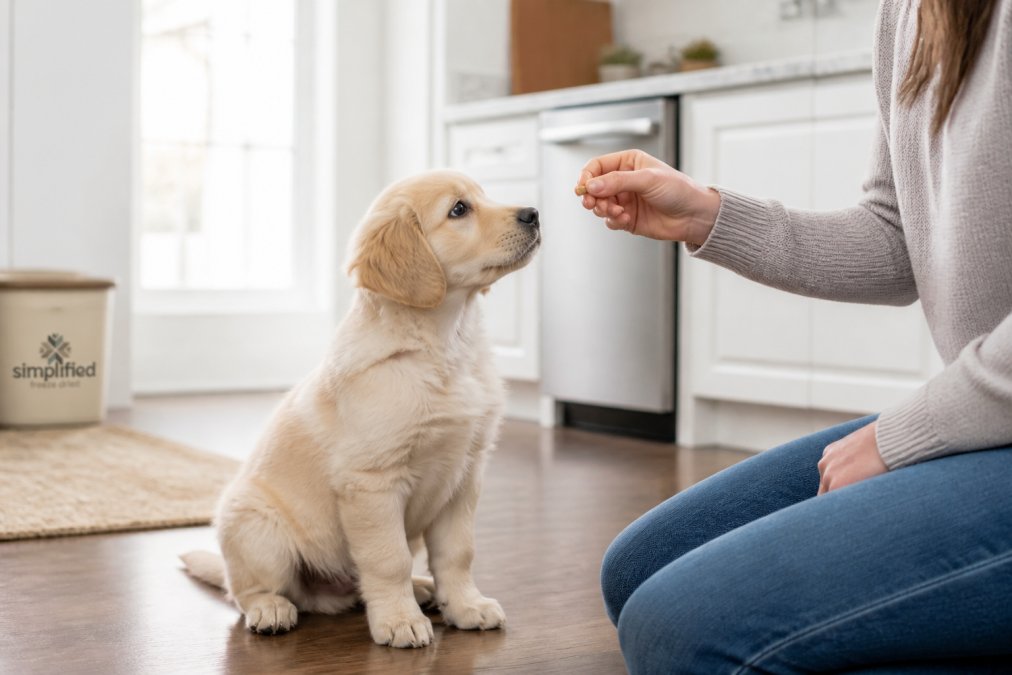
What most guides miss is that single-ingredient doesn't automatically mean training-appropriate. Size and texture decide whether a treat actually works as a reward. A large, crumbly piece takes seconds to chew, which breaks the rhythm of a training session. Simplified Freeze Dried sells its beef liver and pumpkin treats in both regular and kibble-sized pieces, and the smaller size is the one built for training. The regular pieces are better suited to a casual snack, since they're simply too big to hand out repeatedly.
That distinction sounds minor until you're mid-session and your puppy loses focus waiting for a chew to finish.
Healthy Human Food for Dog Training: What's Safe and What's Not
Healthy human food for dog training works well when you stick to plain, unseasoned items. The mistake is assuming "human food" means "people food from the table," which usually means salt, butter, and garlic.
Safe Fruits and Vegetables for Dogs
Safe fruits and vegetables for dogs cover more ground than most owners expect. Plain cooked chicken, shredded into small pieces, is a reliable standby. Small cubes of carrot, green beans, or apple (without seeds) work for many puppies and add fiber-rich bulk without much caloric weight. Plain pumpkin puree is another option, and it's gentle on digestion for most dogs.

A few practical notes:
- Cut everything into pea-sized pieces for training
- Cook proteins without oil, salt, or seasoning
- Introduce one new food at a time so you can spot a reaction
- Keep a mental note of what your puppy tolerates well
Foods to Avoid: Toxic Ingredients for Puppies
Toxic foods deserve a straight answer rather than a vague warning. Several common human foods are genuinely dangerous for puppies, and the reaction can be severe at small body weights.
The American Society for the Prevention of Cruelty to Animals maintains a ASPCA list of people foods to avoid feeding pets that's worth bookmarking. The items that come up most often include:
- Xylitol, a sugar-free sweetener found in gum and some peanut butters
- Grapes and raisins, which can cause kidney damage
- Onions, garlic, and chives, which damage red blood cells
- Chocolate, particularly dark varieties
- Macadamia nuts and alcohol
Best Training Treats for Picky Puppies: Texture, Size, and Value
Best training treats for picky puppies usually come down to three variables: smell, texture, and size. Puppies that ignore a biscuit will often work enthusiastically for something with a stronger aroma. But the variable most owners overlook is how a treat behaves inside a training session, how long it takes to chew, whether it can be swallowed in one motion, and whether it leaves grease in a pocket or pouch.
The training-specific test: size, texture, and residue
A reward only works if it fits the rhythm of repetition. If a piece takes five seconds to chew, you lose the puppy's focus and the timing of your marker. The practical target is a piece roughly the size of a pea, small enough to swallow quickly, large enough to register as a reward.
Texture splits into three useful categories:
- Instant-swallow: freeze-dried liver, tiny shreds of plain cooked chicken. Best for high-repetition sessions where you reward every correct repetition.
- Quick-crunch: small carrot or green bean pieces. Good for puppies that like a little resistance but still finish fast.
- Chew-required: larger freeze-dried pieces, jerky-style strips. These break the rhythm and are better saved for occasional rewards or settling behavior.
Residue matters more than most guides admit. Soft commercial treats and oily meats leave a film on your hands and in a training pouch, which is unpleasant on a warm day and can transfer to your clothes. Freeze-dried treats are dry by nature, so they stay clean in a pocket and don't clump.
Allergy-friendly alternatives for sensitive puppies
Picky eating is sometimes a symptom of sensitivity rather than preference. If your puppy has a known protein or grain sensitivity, the treat rotation has to change, not just the brand.
A common pattern is to build the treat list around a single novel protein the puppy has not eaten before, for example, a puppy on a chicken-based kibble may do better with a liver or turkey reward. Grain-free is not automatically better, but if your veterinarian has flagged a grain issue, single-ingredient freeze-dried proteins avoid the binders and flours that show up in many commercial training treats.
A few practical guardrails:
- Introduce one new protein at a time, over several days, so a reaction is traceable.
- Keep a simple log of what your puppy eats and how it responds.
- If itching, loose stool, or ear issues appear after a new treat, stop it and check with your veterinarian before rotating again.
Here's how the main categories compare for training use:
| Treat Type | Typical Size | Chew Time | Residue | Best For |
|---|---|---|---|---|
| Mini-sized freeze-dried | Pea-sized | Instant | None | High-repetition sessions |
| Regular freeze-dried | Larger | Several seconds | None | Occasional rewards only |
| Shredded boiled chicken | Custom | Instant | Some | Puppies who ignore commercial treats |
| Raw vegetable pieces | Pea-sized | Short | None | Weight management |
| Commercial soft treats | Varies | Instant | Often greasy | Convenience, but check labels |
If your puppy turns its nose up at everything, start with the highest-value option you have and use it only for the hardest behaviors. Save the everyday rewards for lower-stakes repetitions. And when you're choosing a freeze-dried option for training, the mini-sized pieces are the ones built for repetition, the regular size pieces are too big to hand out over and over and are better treated as an occasional snack.
Benefits of Freeze-Dried Treats for Dogs in Training
Benefits of freeze-dried treats for dogs come down to how the process preserves the raw ingredient. Freeze-drying removes moisture at low temperature, which keeps more of the original nutritional profile intact than heat-based cooking or baking does.
That matters for two reasons. First, nutrient-dense food means a smaller piece delivers more value, which suits portion control. Second, minimal processing means fewer opportunities for additives. Simplified Freeze Dried cuts its beef liver once and freeze-dries it, with no imported beef and no denatured meat, only human-grade liver sourced domestically. The pumpkin line uses puree sourced from the Midwest.
There's also a practical benefit owners notice immediately: freeze-dried treats are dry and don't leave residue on your hands or in a training pouch. If you've ever trained with soft treats on a warm day, you understand why that matters.
How to Make Homemade Training Treats: Step-by-Step
Homemade training treats give you full control over ingredients, and the process is simpler than most people assume. Total time: about 45 minutes active, plus drying time. This guide covers both the oven method and the dehydrator method, plus how to prep in bulk so you're not cooking every week.
What you'll need:
- One plain protein (chicken breast, beef liver, turkey, or a novel protein if your puppy has sensitivities)
- A sharp knife and cutting board
- A baking sheet and parchment paper, or a food dehydrator
- Airtight storage container or freezer bags
Step 1: Prep the protein [Time: 10 minutes] Trim any visible fat. Rinse and pat dry. Fat goes rancid faster and can upset a sensitive puppy's stomach, so remove as much as you can.
Step 2: Cut into training-sized pieces [Time: 10 minutes] Cut into pea-sized cubes. Smaller is better here, since you'll be handing these out repeatedly. If you're using liver, partially freezing it first makes clean cubes much easier to cut.
Step 3: Cook or dry [Time: 20-25 minutes active, plus drying]
Oven method: Bake at 300°F on parchment until fully cooked and slightly dried. For a chewier, longer-lasting treat, drop the temperature to 200°F and dry for 2-3 hours, checking every 30 minutes.
Dehydrator method: Set to 155°F for poultry or 145°F for beef liver. Dry until no moisture remains, typically 4-8 hours depending on thickness and your unit. Properly dried pieces should snap, not bend.
Step 4: Cool and store [Time: 5 minutes plus cooling] Let pieces cool completely before storing. Refrigerate for short-term use (about one week) or freeze for longer storage (up to three months).
Step 5: Bulk prep for the month [Time: varies] The real time-saver is batching. Buy protein in family-size packs, prep and dry a full batch in one session, then portion into small freezer bags by the week. Pull one bag to the fridge at a time. This keeps you from running out mid-week and reaching for a commercial bag you didn't plan on.
Expected result: A batch of small, plain, single-ingredient training rewards you can portion out by session.
Allergy-friendly swaps for homemade treats
If your puppy has a protein or grain sensitivity, the recipe above still works, you just swap the protein. Turkey, lamb, or a novel protein your puppy hasn't eaten before are common choices. Skip any recipe that calls for wheat flour, oats, or peanut butter unless you've confirmed your puppy tolerates them. Single-ingredient drying is the safest starting point because there's nothing to trace but the protein itself.
Portion Control and Treat Frequency During Training Sessions
Portion control is where good intentions usually fall apart. Treats are food, and a puppy's daily caloric intake has a ceiling. Overrewarding during training is one of the most common reasons puppies gain weight while their owners believe they're feeding a normal diet.
A workable approach is to set aside a daily treat budget and pull from it during sessions rather than adding on top of regular meals. If you're doing three training sessions a day, measure out the treats for all three at once. When the container is empty, sessions are done for the day.
Treat frequency should also match the difficulty of what you're teaching. New behaviors earn frequent, high-value rewards. Behaviors your puppy already knows well can shift to praise and occasional reinforcement. That shift is what keeps training sustainable over months rather than weeks.
Training a puppy well means rewarding often, and rewarding often means every treat has to earn its place in the daily routine. Simplified Freeze Dried makes that easier with single-ingredient freeze-dried treats in both regular and mini-sized pieces, so you can choose the smaller size for training sessions and save the larger ones for occasional snacks. The line is veteran-owned, made in the Midwest, and built around human-grade ingredients with no fillers or preservatives. Get started with Simplified Freeze Dried and give your puppy rewards you can actually account for.
Frequently Asked Questions
What are the best natural treats for training puppies?
The best natural puppy training treats are single-ingredient, high-value, and small enough to reward quickly without overfeeding. Freeze-dried beef liver and pumpkin are excellent choices because they are nutrient-dense, preservative-free, and highly motivating. Mini-sized or kibble-sized pieces work best for training because they let you reward frequently without filling your puppy up. Avoid anything with xylitol, onions, grapes, or artificial preservatives.
What human foods are safe for puppy training?
Plain boiled chicken, shredded and cut into tiny pieces, is a classic high-reward training treat. Small bits of cooked carrot, plain pumpkin puree, and freeze-dried single-ingredient proteins also work well. Always avoid toxic foods like grapes, onions, garlic, xylitol, and chocolate. Introduce any new food one at a time so you can spot sensitivities, and keep portions small so treats stay under 10% of daily caloric intake.
Are single-ingredient treats better for puppy training?
Single-ingredient dog treats for training are often a better choice because they skip fillers, binding agents, and preservatives that can upset sensitive stomachs or trigger allergies. When the label lists one item, you know exactly what your puppy is eating. This matters for puppies with food sensitivities and for owners who want to keep training rewards clean and simple. Freeze-dried single-ingredient treats also tend to be more nutrient-dense than processed kibble-based treats.
How many treats should I give my puppy during a training session?
Treats should make up no more than 10% of your puppy's daily caloric intake. During a training session, use mini-sized or kibble-sized pieces so you can reward frequently without overfeeding. A good rule is to break each treat into two or three tiny pieces and reward one piece per correct behavior. If you are doing multiple sessions a day, reduce your puppy's regular meal portion slightly to keep their weight on track.