


Last Updated: October 24, 2026
Quick Summary
No, grain-free dog treats are not automatically healthier than grain-inclusive treats. The grain-free label only states what is missing, not that the product is better, and no studies show grain-free diets are better than diets that include grains. Judge a treat on its ingredients, guaranteed analysis, and calories instead.
- True grain allergy in dogs is rare; proteins like beef, chicken, and dairy are far more common triggers.
- The DCM link is unsettled, and most research looks at complete diets, not treats.
- Keep treats to about 10% of your dog's daily calories, with the rest from a complete diet.
- Check the first ingredient, guaranteed analysis, and calorie statement before buying any bag.
- For training, use our mini-sized pieces; regular size pieces are too big for training.
Table of Contents
- Are Grain-Free Dog Treats Actually Healthier? The Short Answer
- Grain-Free vs. Grain-Inclusive Dog Treats: What the Ingredients Actually Tell You
- Can Dogs Digest Grains? Separating Sensitivity From Allergy
- Dog Treats for Food Allergies: How Common Is a True Grain Allergy?
- Dog Food and Treats Linked to DCM: What the Evidence Shows
- How to Read Dog Treat Labels Without Getting Fooled
- Calories, Portion Size, and Treat Intake: The Part Most Owners Skip
- Pick a Treat You Can Actually Verify
- Frequently Asked Questions
Are Grain-Free Dog Treats Actually Healthier? The Short Answer
No. Grain-free dog treats are not automatically healthier than grain-inclusive treats.
The grain-free label describes what's missing, not what's better.
Here's what most guides get wrong: they treat "grain-free" as a health claim. It isn't one. It's an ingredient statement.
Below, we'll show you exactly how to judge a treat on what actually matters, from ingredient quality to portion size.
Grain-Free vs. Grain-Inclusive Dog Treats: What the Ingredients Actually Tell You
Grain-free and grain-inclusive dog treats differ only in whether they contain grains. Neither label says anything about overall nutritional value, protein quality, or how well your dog will tolerate the food.
What Grains Bring to the Bowl
Grains supply carbohydrates for energy and fiber that supports digestion. That's a plain nutritional role, not a flaw.
Oats, barley, and rice are common examples. For most dogs, these ingredients are digestible and useful.
Dr. Kurt Venator, Chief Veterinary Officer at Purina, put it directly:
"Grains are actually an excellent nutrient source." -- Dr. Kurt Venator, Chief Veterinary Officer at Purina (Purina, "Is Grain Free Dog Food Good for Dogs")
What Replaces the Grain
When a maker removes grain, something has to fill the gap. Often that means peas, lentils, or potatoes.
Those swaps can work fine. But they also raise the protein and fat levels in many formulas, according to a 2025 review of grain-free diets for dogs and cats.
Higher protein isn't automatically better for a dog who sits on the couch all day.
Can Dogs Digest Grains? Separating Sensitivity From Allergy
Most dogs digest grains without any trouble. True grain allergy is uncommon, and food sensitivity is a different issue entirely.
A food sensitivity can cause loose stool or itching without any immune response. A true allergy involves the immune system and usually shows up as skin or digestive problems.
If you suspect your dog reacts to grains, the right move is a conversation with your veterinarian, not a label swap at the pet store.
Watch out: switching to a grain-free treat to "test" a suspected allergy often tells you nothing, because the real trigger may be a protein like chicken or beef. You can read more about the difference in signs of grain allergy in dogs.
Dog Treats for Food Allergies: How Common Is a True Grain Allergy?
True grain allergy in dogs is rare.
That's the part most owners miss. They buy grain-free treats for an itchy dog, and the itching continues because the culprit was never the grain.
GoodRx notes that no studies show grain-free diets are better than diets that include grains.
If your dog has a diagnosed allergy, read the full ingredient list on every treat. Single-ingredient treats make that job much simpler.
Dog Food and Treats Linked to DCM: What the Evidence Shows
The link between grain-free diets and dilated cardiomyopathy (DCM) is not settled.
DCM is a heart condition that weakens the muscle and reduces pumping ability.
The 2025 review describes ongoing controversy and notes that grain-free diets may potentially affect cardiovascular health.
Here's the key distinction for treat buyers: most of this research looks at complete diets, not treats.
Still, if your dog eats a grain-free complete diet, mention it at your next vet visit.
How to Read Dog Treat Labels Without Getting Fooled
Reading a dog treat label comes down to four checks: the ingredient list, the guaranteed analysis, the calorie statement, and whether the front-of-bag claims match what's inside. Most owners stop at the ingredient list, which is why the grain-free label keeps winning arguments it shouldn't.
Simplified Freeze Dried Beef Liver Treats for Dogs & Cats →
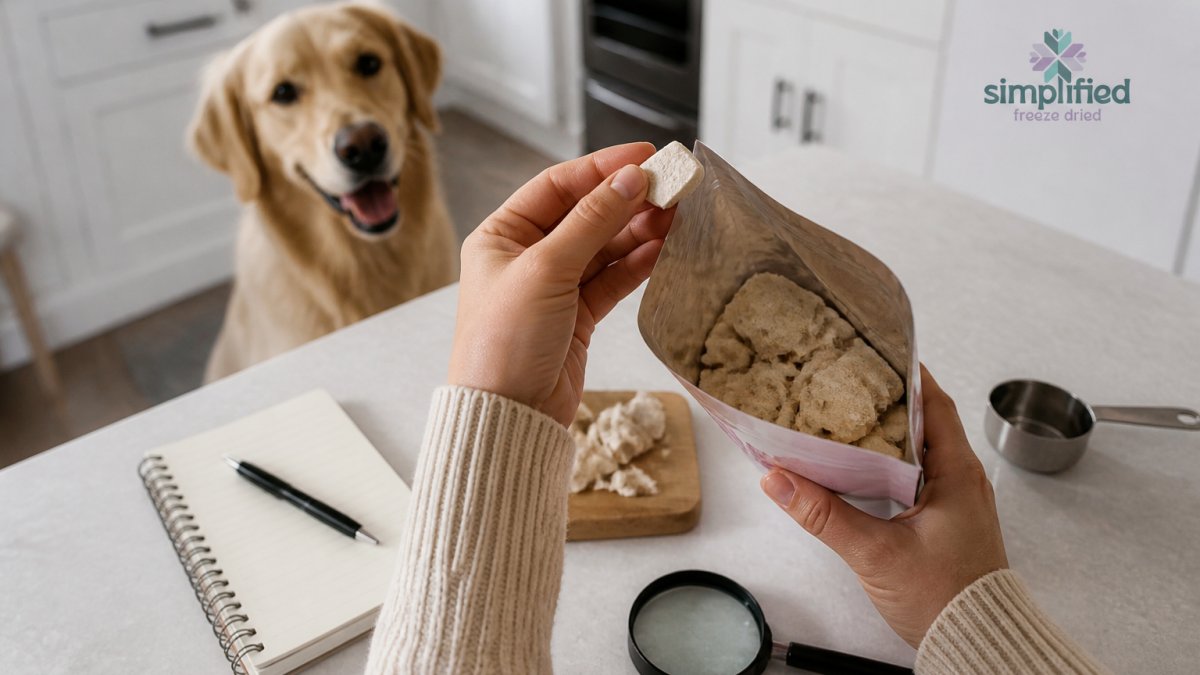
Start with the ingredients. They're listed by weight, so the first few names matter most. A named meat like beef liver near the top tells you more than any claim on the front of the bag.
The Four-Point Label Checklist
Use this on your next bag, and compare two bags side by side rather than judging one in isolation:
- First ingredient: Is it a named animal source, like beef liver or chicken, rather than a vague "meat" or "meat meal"?
- Ingredient length and swaps: Is the list short, or is it padded with fillers? If it's grain-free, what replaced the grain, peas, lentils, potatoes, or tapioca? Those swaps are why grain-free does not automatically mean low-carbohydrate or more nutritious.
- Guaranteed analysis: Does it show protein, fat, fiber, and moisture? These are minimums and maximums, not exact values, so use them to compare products, not to calculate a diet.
- Calorie statement: Does the label give a calorie content, usually as kcal per treat or kcal per kilogram? Without it, you cannot portion treats against your dog's daily intake.
What the Label Legally Can and Cannot Tell You
Treat labels are regulated differently from complete diets. A complete-and-balanced statement (often worded as meeting the nutritional adequacy standards of the Association of American Feed Control Officials, or AAFCO) means the product is formulated to serve as a sole diet.
That distinction matters for the grain-free question. A grain-free treat without an adequacy statement is a snack, not a nutritional plan. Do not let a front-of-bag claim stand in for a statement that isn't there.
Check for the Allergen, Not the Grain
If your dog has a diagnosed or suspected allergy, scan the list for the protein your veterinarian identified, commonly beef, chicken, or dairy, rather than for grain. A grain-free treat built on chicken is no help to a chicken-allergic dog.
For a deeper walkthrough, see how to read dog food labels for allergens and how to identify hidden fillers in dog treats.
Run these four checks on any bag before you buy.
| Check | What to look for | Why it matters |
|---|---|---|
| First ingredient | A named animal source, like beef liver or chicken | Tells you more than any front-of-bag claim |
| Ingredient length and swaps | Short list; note what replaced the grain | Grain-free does not mean low-carb or more nutritious |
| Guaranteed analysis | Protein, fat, fiber, and moisture | Minimums and maximums, so compare products only |
| Calorie statement | kcal per treat or kcal per kilogram | Without it, you cannot portion treats |
Calories, Portion Size, and Treat Intake: The Part Most Owners Skip
Treat calories count toward your dog's daily intake, and a treat that looks small can add up fast, especially during training sessions with many repetitions. This is the section most grain-free debates skip entirely, and it matters more than the label for most dogs.
The 10% Rule of Thumb
A commonly cited guideline among veterinarians and pet nutrition sources is to keep treats to about 10% of a dog's daily calories, with the rest coming from a complete and balanced diet.
To use it, you need two numbers: your dog's daily calorie target and the calories per treat. Your veterinarian can help establish the first. The second should be on the label; if a treat doesn't state calories, that's a reason to pick a different treat.
A Worked Example
Suppose your veterinarian sets your dog's daily intake at a round number of calories. Ten percent of that is the treat budget for the day. If each treat is a small fraction of that budget, you can reward many times in a session; if each treat is a large share, a handful of rewards uses up the day's allowance. The math is simple, but it only works if you measure treats out rather than free-feeding from the bag.
Training Mechanics: Small Pieces, More Repetitions
Training is where treat calories quietly pile up, because a single session can involve dozens of rewards. The practical fix is to keep rewards tiny and count them.
This is exactly where our mini-sized pieces fit: they're built for training, so you can reward repeatedly without blowing through the day's treat budget. Our regular size pieces are for treats only, they're too big for training.
Set Aside, Don't Add On
The cleanest habit is to set aside a portion of the daily food ration for treats rather than adding treats on top of a full meal. If you are training heavily, reduce the meal slightly to keep the daily total steady, and confirm the adjustment with your veterinarian if your dog is on a prescribed diet.
If your dog gets too many single-ingredient treats in one sitting, you can read about what happens when a dog eats too many single-ingredient treats.

Pick a Treat You Can Actually Verify
The best treat is one you can check in seconds.
At Simplified Freeze Dried, we keep it simple. Our treats are single-ingredient and freeze-dried fresh.
We're a veteran-owned, family business, and we use only 100% American beef liver. No imported beef, no denatured meat, and no fillers.
Our freeze-dried beef liver treats for dogs and cats are minimally processed: cut once, then freeze dried.
For training, our mini-sized pieces are the right call.
Frequently Asked Questions
Are grain-free dog treats actually healthier than treats with grains?
Not automatically. No research establishes that grain-free is better as a category, and a 2025 review in PubMed Central describes the advantages and disadvantages as still under debate. Grains supply carbohydrates for energy and fiber that supports digestion, as Purina's chief veterinary officer notes. Whether a treat is healthier depends on ingredient quality, how much of the diet it represents, and your individual dog's needs rather than the presence or absence of grain.
Can grain-free dog treats be linked to heart problems in dogs?
The concern comes from the wider discussion of dog food and treats linked to DCM, a form of heart disease. The evidence is not settled: a 2025 review notes that grain-free diets may potentially affect cardiovascular health, while other 2026 commentary points to Dog Aging Project data finding no significant association between grain-free feeding and new cardiac diagnoses. That research examines complete diets, not treats. Ask your veterinarian if your dog eats a grain-free complete diet.
When might a dog need grain-free treats?
Only when a specific problem points that way. Some owners report better results for dogs with chronic soft stool, itching, or gastrointestinal upset, though that is a general claim rather than a measured outcome. A true grain allergy is uncommon, and suspected food allergies need a proper diagnosis, often through an elimination diet guided by a veterinarian. Single-ingredient treats make elimination trials easier to control because you know exactly what you are feeding.
How do I choose a simple treat for a dog with a sensitive stomach?
Start with a short ingredient list. A single-ingredient freeze-dried treat, such as Simplified Freeze Dried's beef liver or pumpkin biscuits, gives you one variable to track instead of a dozen. Introduce it in small amounts, keep the rest of the diet steady, and watch stool quality over several days. For training, use the mini-sized pieces so rewards stay small; the regular size pieces work better as a standalone snack.
The grain-free aisle is crowded, and most of it is marketing. What your dog actually needs is a short ingredient list you can trust.
Simplified Freeze Dried makes single-ingredient treats with no fillers and no guesswork. Our mini-sized pieces are built for training, our regular pieces work as everyday rewards, and both are suitable for dogs and cats.
Get started with Simplified Freeze Dried and give your dog a treat you can verify.
