


Table of Contents
- Why Ingredient Quality in Dog Treats Matters More Than You Think
-
How to Read Dog Treat Labels Like a Pro
- Step 1: Find the Ingredient List, Not the Marketing Panel
- Step 2: Identify the First Named Animal Source
- Step 3: Check for Split Ingredients
- Step 4: Scan for Preservatives, Colors, Sweeteners, and Humectants
- Step 5: Read the Guaranteed Analysis and Calorie Statement
- A Worked Example
- What the Label Can't Tell You
- Dog Treat Ingredients to Avoid: A Numbered Checklist
- Dog Treat Ingredient List Examples: Good vs. Bad
- Choosing Treats for Dogs with Food Sensitivities
- How Processing and Sourcing Affect Treat Quality
- Conclusion: Build a Simple Label-Checking Habit
- Frequently Asked Questions
Last Updated: October 12, 2026
Why Ingredient Quality in Dog Treats Matters More Than You Think
Most dog parents read the front of the bag, not the back. That's the first mistake. Learning how to spot low quality dog treat ingredients starts with one simple shift: flip the package over and read what's actually inside.
At Simplified Freeze Dried, we've built our whole business around single-ingredient treats, so we think about labels constantly. A treat is only as good as what goes into it.

Here's the good news: you don't need a nutrition degree to tell a clean label from a messy one. You need a system.
How to Read Dog Treat Labels Like a Pro
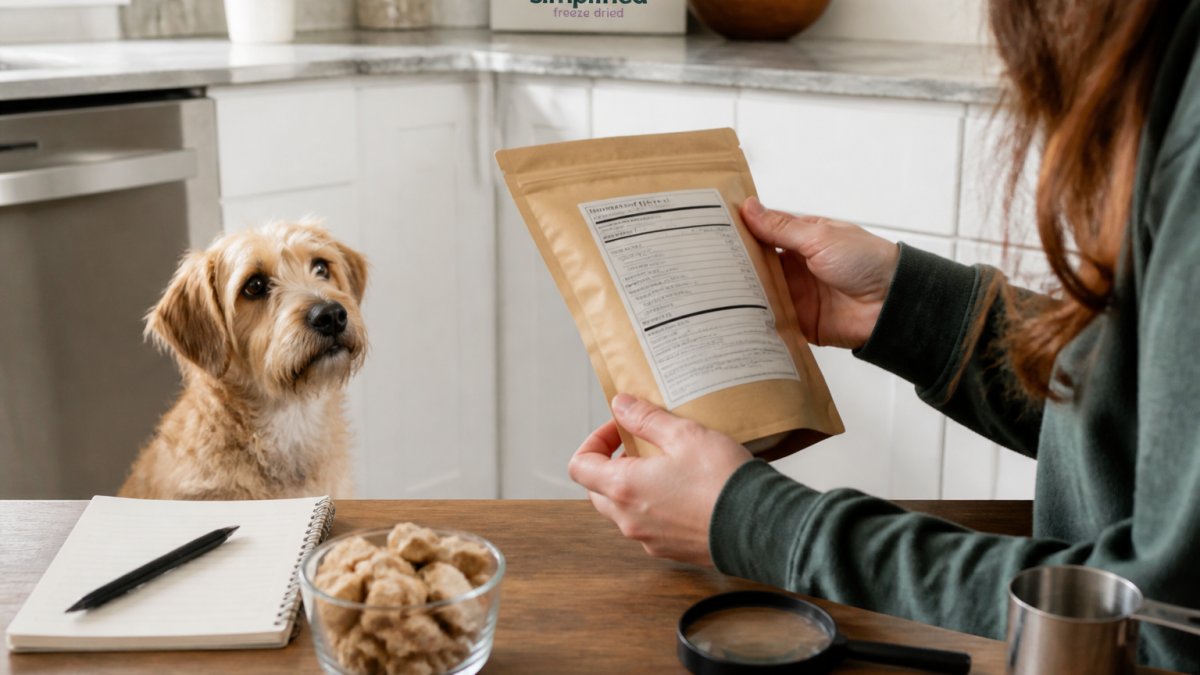
Most guides tell you to 'read the label' and stop there. That's not a method. Here's a repeatable five-step process you can run on any bag in about a minute, plus a worked example so you can see it in action.
Step 1: Find the Ingredient List, Not the Marketing Panel
The front of the bag is advertising. The ingredient list and the guaranteed analysis are the facts. Ingredients are listed by weight before processing, so the order tells you what the recipe leans on most. The first five items carry the most weight; anything after the midpoint is usually present in small amounts.
Step 2: Identify the First Named Animal Source
Look for a specific animal and a specific tissue: beef liver, chicken, salmon, turkey meal. Terms like 'meat,' 'meat meal,' 'poultry,' or 'animal by-products' are umbrella terms that can cover a wide range of source animals and tissues. A named source doesn't automatically mean high quality, but an unnamed one tells you almost nothing.
Step 3: Check for Split Ingredients
Manufacturers sometimes break one ingredient into several forms so no single form lands high on the list. You might see 'wheat flour, wheat bran, wheat germ' or 'corn, corn gluten meal, corn syrup.' Read them as one ingredient and mentally add their positions together. If the combined weight would push it into the top three, treat it as a top-three ingredient.
Step 4: Scan for Preservatives, Colors, Sweeteners, and Humectants
Run your finger down the list and flag:
- Preservatives: BHA, BHT, ethoxyquin, propylene glycol, potassium sorbate, sodium nitrite
- Colors: FD&C Red 40, Yellow 5, Yellow 6, Blue 2, titanium dioxide
- Sweeteners: corn syrup, cane sugar, molasses, sorbitol, xylitol (xylitol is toxic to dogs)
- Humectants and texturizers: propylene glycol, glycerin, carrageenan, guar gum
Not every item on this list is dangerous at every dose. Some are mainly markers of a highly processed product. The point is to notice how many appear and how high they sit.
Step 5: Read the Guaranteed Analysis and Calorie Statement
The guaranteed analysis gives minimum protein and fat and maximum fiber and moisture. The calorie statement (often 'kcal ME/kg' or 'kcal ME/treat') tells you energy density. A treat that is 30% fat by guaranteed analysis is a very different snack from one that is 5% fat, even if both lists look clean.
A Worked Example
Label A: Beef liver.
One ingredient. Named animal, named organ, no preservatives, no colors, no fillers.
Label B: Wheat flour, beef, corn gluten meal, chicken by-product meal, beef fat (preserved with BHA), propylene glycol, salt, artificial flavor, Red 40.
Run the steps: the first named animal source is 'beef,' but it sits behind wheat flour. 'Chicken by-product meal' is unnamed tissue.
Label C: Chicken, chicken meal, brown rice, oatmeal, chicken fat (preserved with mixed tocopherols), flaxseed, salt.
Named animal first, named animal meal second, whole grains, a natural preservative (mixed tocopherols are vitamin E), and one modest palatant.
What the Label Can't Tell You
An ingredient list is a recipe, not a report card. It won't tell you the source of the ingredients, whether the batch was tested for contaminants, how the food was stored, or whether the manufacturer owns the plant. Those are separate questions, and we cover them in the sourcing section below.
Dog Treat Ingredients to Avoid: A Numbered Checklist
The clearest way to spot a low quality dog treat is to scan for a short list of problem ingredients. Here's what to look for, in order of how often we see it.
1. Artificial Preservatives (BHA, BHT, Ethoxyquin)
These chemical preservatives keep fat from going rancid, but they're worth avoiding when you have a choice. Many pet parents prefer preservative-free treats that rely on drying or freeze-drying instead.
2. Artificial Colors and Flavors
Dogs don't care if a treat is bright red. Artificial colors and flavors exist for the human eye, not the dog's nose. Skip them.
Simplified Freeze Dried Beef Liver Treats for Dogs & Cats →
3. Refined Sugars and Artificial Sweeteners
Refined sugar and artificial sugar add empty calories. Some sweeteners are worse than others, so read carefully and avoid anything you wouldn't eat yourself.
4. Fillers, By-Products, and Vague Meat Meals
Fillers like corn, soy, and wheat bulk up a treat without adding much nutritional value. Meat by-products and vague meat meals fall in the same bucket. Look for a named animal protein instead.
Dog Treat Ingredient List Examples: Good vs. Bad
The fastest way to learn this skill is to compare two lists side by side. Here's how a clean label stacks up against a messy one.
| What You See | Good Sign | Bad Sign |
|---|---|---|
| First ingredient | Named protein (beef liver) | "Meat meal" or "by-products" |
| Ingredient count | One to five items | Fifteen or more |
| Preservatives | None, or natural | BHA, BHT, ethoxyquin |
| Colors and flavors | None | Artificial colors, flavors |
| Sweeteners | None | Refined sugar, syrups |
| Fillers | None | Corn, soy, wheat |
A good label reads like a shopping list. A bad one reads like a chemistry set.
Choosing Treats for Dogs with Food Sensitivities
For dogs with food sensitivities, the safest treats are the ones with the fewest ingredients. A single-ingredient treat removes most of the guesswork.
If your dog reacts to chicken, for example, a beef liver treat skips that trigger entirely. You know exactly what's in the bag because there's only one thing in it.
This is where our approach matters. Our treats are single-ingredient, freeze-dried, and made with 100% American beef liver or 100% American pumpkin. No fillers, no additives, nothing to decode. For a dog with allergies, that simplicity is the whole point.
How Processing and Sourcing Affect Treat Quality
Ingredient lists tell you what's in a treat. They don't tell you how it was made, where it came from, or whether the batch was tested. Those are the questions that separate a clean label from a genuinely trustworthy product. Here's how to evaluate them.
Processing Methods, Ranked by How Much They Preserve
- Freeze-drying: Sublimates ice from frozen product under vacuum. Retains most nutrients and structure, needs no preservatives, and rehydrates well. Higher cost per ounce.
- Dehydration: Uses low, circulating heat to remove moisture. Retains most nutrients, no preservatives needed, but heat-sensitive vitamins can degrade somewhat.
- Baking: Higher heat. Kills pathogens and creates shelf stability, but degrades more nutrients and often requires binders or preservatives.
- Extrusion (typical kibble-style treats): High heat and pressure. Requires starches and often palatants and preservatives to hold shape and stay shelf-stable.
- Semi-moist treats: Rely on humectants like propylene glycol or glycerin to stay soft. Often the most heavily formulated category.
A treat can be single-ingredient and still be poorly made. Processing is the variable the ingredient list hides.
Sourcing Signals You Can Actually Check
- Named origin: 'Made with beef liver from cattle raised in the U.S.' is a checkable claim. 'Beef liver' with no origin is not.
- Human-grade vs. feed-grade: Human-grade means the ingredient was handled under standards suitable for human food. Feed-grade does not. The term 'denatured' refers to meat rendered unfit for human consumption, often with a denaturing agent added.
- Single-plant vs. co-packed: A brand that owns and operates its own facility has more control over allergens, cross-contamination, and batch consistency than one that contracts out production.
- Lot and batch codes: A visible lot code means the manufacturer can trace a batch if something goes wrong. No lot code is a transparency gap.
- Third-party testing: Look for stated testing for pathogens (Salmonella, Listeria), heavy metals, and mycotoxins. 'Tested' without specifics is marketing; 'tested for Salmonella and heavy metals, results available on request' is a signal.
What 'Human-Grade' and 'Denatured' Actually Mean
Human-grade is a handling standard, not a nutritional claim. It means the ingredient was processed in a facility that meets human-food requirements. Denatured meat is meat that has been treated so it cannot be sold for human consumption, often because it was unfit for that channel. Neither term appears on most labels, which is why asking the manufacturer directly is often the only way to know.
How We Apply This
Our treats are single-ingredient, freeze-dried, and made with 100% American beef liver or 100% American pumpkin. We don't use denatured meat. Our beef liver is human-grade, cut once, then freeze-dried to preserve as much nutrition as possible. Fewer steps mean fewer chances for something to go wrong.
A Note on Treat Size and Training
If you're using treats for training, size matters as much as ingredients. Our mini-sized pieces are built for frequent rewards during sessions. The regular size pieces are for treats only, they're too big for training.
Conclusion: Build a Simple Label-Checking Habit
The trick to spotting a low quality dog treat isn't memorizing a hundred ingredients. It's building a 10-second habit.
- Flip the bag and read the first five ingredients
- Look for a named protein, not a vague one
- Scan for artificial preservatives, colors, and sweeteners
- Count the ingredients; fewer is usually better
- Skip anything you can't picture as real food
Do that every time you buy, and you'll rarely get fooled.
Frequently Asked Questions
What should I look for on a dog treat label?
Start with the ingredient list. Look for a named animal protein as the first ingredient, such as beef liver or chicken. Avoid vague terms like meat meal or animal by-products. Check for artificial preservatives like BHA, BHT, and ethoxyquin, as well as artificial colors and flavors. A short list of recognizable whole-food ingredients is a strong sign of quality.
Are fillers in dog treats always bad?
Not always, but they often signal lower nutritional value. Ingredients like corn, wheat, and soy are common fillers that add bulk without much benefit. Some dogs with food sensitivities may react to these grains. If a treat lists fillers high on the ingredient list, it likely contains less of the protein or nutrient you are paying for, so choose treats with named proteins and minimal extras.
How can I choose treats for a dog with food sensitivities?
Start with single-ingredient treats that contain only one protein or food source, such as freeze-dried beef liver or pumpkin. This makes it easy to identify what works and what does not. Avoid treats with long ingredient lists, artificial additives, and common allergens like chicken or grains unless your vet says otherwise. Introduce one new treat at a time and watch for reactions.
Are single-ingredient dog treats a good choice?
Yes, for many dogs. Single-ingredient treats like freeze-dried beef liver or pumpkin contain no fillers, preservatives, or artificial additives. They are easy to digest and ideal for dogs with allergies because you know exactly what you are feeding. They also work well for training, especially in small kibble-sized pieces that are quick to eat and easy to carry.
Picking the right treat shouldn't feel like detective work. At Simplified Freeze Dried, we keep it simple with single-ingredient, freeze-dried treats made from 100% American beef liver and pumpkin, in regular and mini kibble-sized pieces that are perfect for training. No fillers, no additives, nothing to decode. Get started with Simplified Freeze Dried and give your dog a treat you can actually read.